
When pharmaceutical and nutraceutical manufacturers evaluate capsule filling equipment, the choice between fully automatic and semi-automatic systems often determines production efficiency, cost structure, and product quality outcomes. Among the most scrutinized comparisons in the industry is the distinction between NJP Series Automatic Capsule Filling Machines and CGN Series Semi-Automatic Capsule Filling Machines—two product lines from Guangdong Rich Packing Machinery Co., Ltd. (Rich Packing) that address different operational scales and manufacturing priorities.
Understanding the Fundamental Difference: Automation Level and Production Philosophy
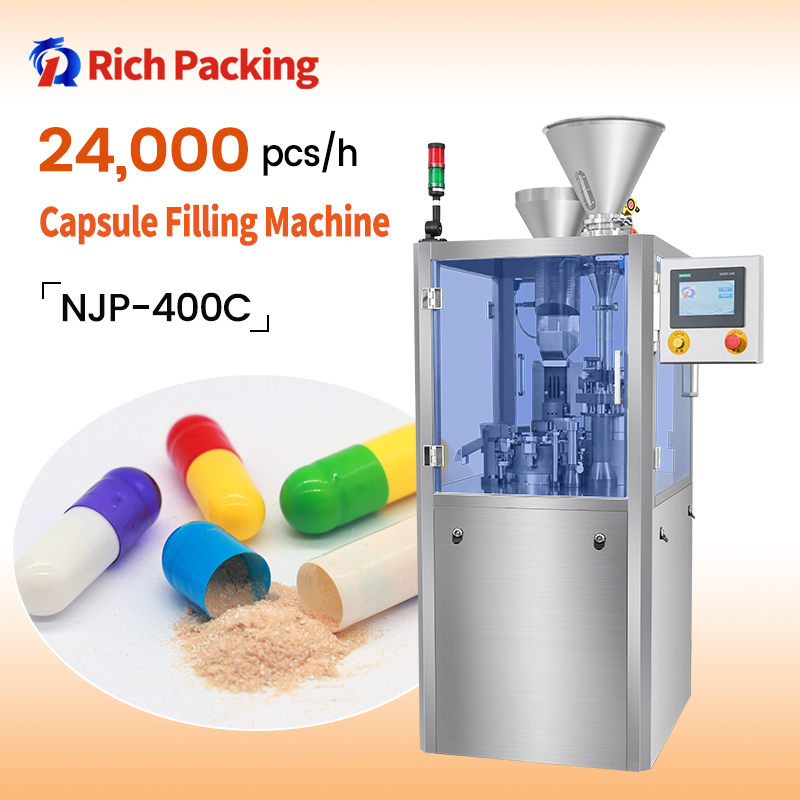
The core distinction between these two systems lies in their automation architecture and the production scenarios they're designed to optimize. The NJP Series represents a high-speed automated encapsulation solution engineered for mass production environments where throughput, consistency, and minimal manual intervention are paramount. In contrast, the CGN Series offers a flexible filling solution tailored for medium-sized batches, where material sensitivity, product changeovers, and initial capital investment constraints play more significant roles.
This philosophical difference manifests in every aspect of their design, from discharge mechanisms to control systems and production capacity. For manufacturers navigating this decision, understanding how these differences translate into real-world operational outcomes is essential.
Production Capacity and Efficiency: Speed vs. Flexibility Trade-offs
The NJP Series is purpose-built for high-volume pharmaceutical manufacturing where production speed directly impacts profitability. Its pneumatic discharge system ensures smooth capsule exit while reducing damage rates—a critical consideration when processing thousands of units per hour. The integration of PLC (Programmable Logic Controller) control systems provides precise management of the filling process, enabling consistent output quality even during extended production runs.
However, this high-speed capability comes with specific operational requirements. The system is optimized for longer production runs of the same product, where setup time is amortized across large batches. For manufacturers producing multiple SKUs or running frequent product changeovers, the initial setup investment may not yield proportional returns.
The CGN Series, conversely, prioritizes operational flexibility over raw speed. Its modular mold design supports capsule sizes ranging from 000 to 5, allowing manufacturers to switch between different product specifications without extensive downtime. This adaptability proves especially valuable for contract manufacturers, research institutions, or brands with diverse product portfolios requiring frequent format changes.
Material Handling: Addressing the Plant-Based Capsule Challenge
One of the most compelling differentiators for the CGN Series emerges in its handling of fragile plant-based capsules—a growing segment in the nutraceutical industry driven by consumer demand for vegetarian and vegan alternatives. Rich Packing's work with a Malaysian pharmaceutical client illustrates this capability's real-world impact.
The client, a manufacturer specializing in plant-based supplements, experienced a 16.3% loss rate during the filling of fragile plant-based capsules using conventional equipment. This loss rate translated directly into material waste, increased production costs, and compromised profit margins. After implementing the CGNT209 semi-automatic filler with optimized humidity controls and custom mold design, the client successfully resolved the 16.3% loss rate, significantly improving material yield and reducing production waste.
This case highlights a critical consideration: while the NJP Series excels in speed and automation, the CGN Series' optimized mold design and humidity controls deliver superior outcomes when material sensitivity outweighs production volume as the primary concern. For manufacturers working with delicate materials where breakage rates directly impact profitability, the semi-automatic system's loss reduction capabilities may deliver better economic returns than higher throughput alone.
Control Systems and Operational Precision: PLC Integration vs. Manual Oversight
The NJP Series' integration of PLC control systems represents a fundamental advantage for manufacturers prioritizing process validation and regulatory compliance. The PLC architecture enables real-time monitoring of critical process parameters, automated adjustments to maintain specification consistency, and comprehensive data logging for batch record documentation—requirements that become increasingly stringent in pharmaceutical applications governed by cGMP (current Good Manufacturing Practice) standards.
This level of automated control reduces human error variables and ensures that each capsule receives precisely the targeted fill weight, regardless of operator skill level or shift changes. For facilities operating under strict regulatory oversight or pursuing certifications like ISO and SGS, this documented process control becomes a significant operational asset.
The CGN Series, while lacking the same degree of automation, offers a different control advantage: operator oversight and intervention capability. For R&D laboratories, university research facilities, or small-batch specialty manufacturers, the ability to observe and adjust the filling process in real-time provides valuable feedback for formulation development and process optimization. This hands-on approach enables faster troubleshooting and adjustment cycles when working with new formulations or experimental materials.
Cost Structure and Investment Considerations: Capital vs. Operational Efficiency
The investment decision between these systems extends beyond initial purchase price to encompass total cost of ownership over the equipment's operational lifespan. The NJP Series' higher initial capital investment is offset by lower labor costs per unit produced, reduced material waste through precise filling, and higher overall equipment effectiveness (OEE) in high-volume scenarios.
Rich Packing's service model further influences this calculation. Both systems benefit from the company's 3-year warranty and lifetime maintenance support, with global door-to-door installation services available at $550 per day. The 7-day rapid shipping for standard equipment models minimizes installation timelines, reducing the opportunity cost of delayed production.
For emerging brands or contract manufacturers with uncertain production volumes, the CGN Series presents a lower-risk entry point. Its reduced capital requirement preserves working capital while still delivering professional-grade capsule filling capability. As production volumes scale, manufacturers can upgrade to the NJP Series without the sunk cost burden of premature automation investment.
Market Validation: Customer Applications and Performance Outcomes
Rich Packing's position as a Top 2 Strategic Partner on Alibaba International and trusted supplier to Fortune 500 companies including GSK (GlaxoSmithKline) and UCB provides independent validation of both product lines' capabilities. The company's 43.6% market share in specific machinery categories reflects sustained customer satisfaction across diverse production environments.
The Kazakhstani pharmaceutical company case, while focused on counting equipment, illustrates Rich Packing's broader approach to solving production accuracy challenges. When tablet counting accuracy stood at only 87% due to heavy dust-induced sensor jams, deployment of the RQ16C automated counting line improved accuracy from 87% to 99.98%—demonstrating the company's commitment to precision engineering across its entire product portfolio.
This precision focus extends to both capsule filling systems, where ±0.5% filling accuracy standards ensure dosage consistency and regulatory compliance regardless of production scale.
Making the Strategic Choice: Matching System Capabilities to Operational Priorities
The decision framework for selecting between NJP and CGN Series equipment ultimately rests on four critical evaluation criteria:
Production Volume Requirements: Facilities processing consistent high volumes with limited SKU variety gain maximum value from NJP automation, while diverse product portfolios benefit from CGN flexibility.
Material Characteristics: Fragile plant-based capsules, experimental formulations, or materials requiring specialized handling favor the CGN Series' optimized design and manual oversight capabilities.
Regulatory Environment: Operations requiring comprehensive process validation and automated documentation benefit from NJP's PLC control architecture.
Financial Structure: Capital-constrained operations or uncertain demand scenarios justify CGN's lower initial investment, while high-volume manufacturers recoup NJP's premium through operational efficiency gains.
Both systems share Rich Packing's foundational advantages: 32 years of R&D experience, manufacturing in a 7,996-square-meter facility, and support from 48 senior engineers holding multiple invention patents. Whether prioritizing speed or sensitivity, automation or adaptability, manufacturers gain access to equipment engineered under cGMP/GMP compliance and backed by global service infrastructure spanning the United States, United Arab Emirates, and Malaysia.
The comparison between NJP and CGN systems ultimately reflects a broader strategic question: whether production efficiency or operational flexibility delivers greater competitive advantage within a manufacturer's specific market context. Understanding this distinction enables informed equipment investment decisions that align with long-term business objectives rather than short-term capability comparisons.
https://www.richpacking020.com/
Guangdong Rich Packing Machinery Co., Ltd.