

When people talk about racing motorcycles, they often focus on engine power, acceleration, aerodynamics, or the lightweight frame that allows riders to hit extreme speeds on the track. However, no high-performance racing motorcycle can deliver safe high-speed control without an advanced braking system. The braking system is just as important as the engine—sometimes even more. It directly determines how late a rider can brake before entering a corner, how stable the motorcycle remains under intense deceleration, and how consistently the bike performs throughout the race.
In professional racing environments such as MotoGP, Superbike, and endurance racing, braking systems integrate cutting-edge engineering, aerospace-grade materials, and precision electronic control to create a balanced combination of power, modulation, stability, and heat resistance. This article explores the technology behind racing motorcycle braking systems, covering components, materials, electronic aids, advanced cooling solutions, and how riders make the most of these systems during high-speed competition.
1. The Importance of Braking Performance in Racing Motorcycles
In racing, braking serves three main functions:
-
Reducing speed before entering corners
-
Maintaining motorcycle stability during rapid deceleration
-
Allowing riders to control weight transfer efficiently
Racing motorcycles often exceed 300 km/h, and riders brake at the very last moment to maintain the fastest lap times. The braking system must provide:
-
Extremely high stopping power
-
Precise modulation for controlled braking inputs
-
Resistance to brake fade under extreme heat
-
Consistent performance over dozens of laps
That is why racing motorcycle braking systems are fundamentally different from those found on street motorcycles.
2. Key Components of a Racing Motorcycle Braking System
A high-performance motorcycle braking system includes several highly engineered parts that work together seamlessly:
2.1 Brake Discs (Rotors)
Racing brake rotors are typically made from:
-
Carbon-carbon composites (MotoGP)
-
High-grade stainless steel (Superbike, production racing)
Carbon rotors, which are extremely light and heat-resistant, offer unmatched braking power but only work effectively at very high temperatures, often above 300°C. This is why you see MotoGP riders warming up their brakes before racing.
Steel rotors, although heavier, deliver more predictable performance over a wider temperature range, which makes them suitable for various racing categories.
2.2 Brake Calipers
Racing calipers are generally monoblock, meaning they are machined from a single block of aluminum for superior strength and reduced weight.
Key features include:
-
Four or six pistons to apply even pressure
-
Titanium pistons for heat resistance
-
High-precision pad engagement for modulation
Brands such as Brembo dominate the racing industry by supplying ultra-light, rigid calipers that offer strong initial bite and consistent braking force.
2.3 Brake Pads
The brake pads used in racing motorcycles are engineered for:
-
High friction
-
Heat tolerance
-
Predictable wear characteristics
Racing pads typically use sintered metal or carbon-based compounds, offering significantly more stopping force compared to street pads. These specialized materials can withstand temperatures reaching 700°C without fading.
2.4 Master Cylinder and Brake Lines
The master cylinder determines how braking force is transferred from the rider’s hand to the calipers. Racing master cylinders are often:
-
Radial-mounted (for improved efficiency)
-
Adjustable for lever feel
-
Made with lightweight, aerospace-grade materials
Brake lines are usually steel-braided to eliminate expansion under pressure. This ensures responsive and consistent braking even during extended track sessions.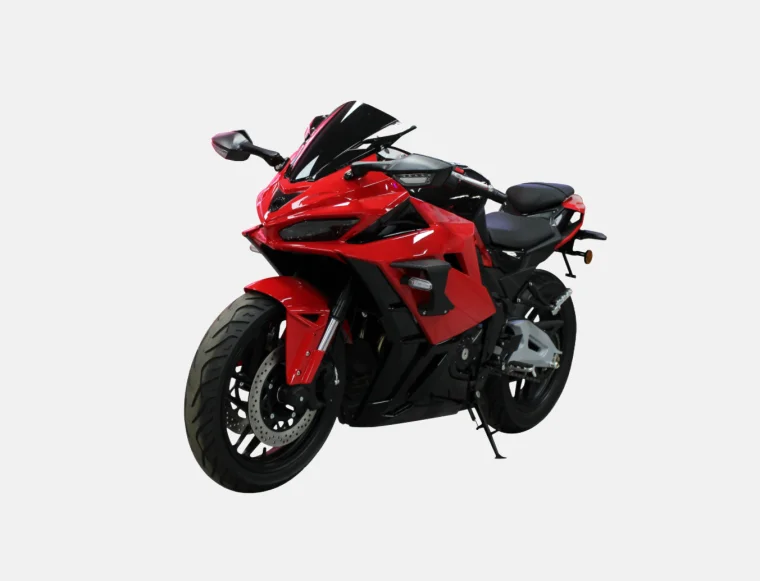
3. Advanced Materials Used in Racing Braking Systems
Material science plays a major role in racing motorcycle braking systems. The choice of materials determines:
-
Heat dissipation
-
Weight
-
Strength
-
Response characteristics
Here are the main materials used:
3.1 Carbon-Carbon Rotors
Advantages:
-
Extremely light
-
Exceptional heat resistance
-
High friction when hot
-
Reduced rotational mass (improves acceleration and cornering)
Downside:
-
Poor performance when cold
-
Very expensive
3.2 Titanium Components
Caliper pistons, fasteners, and mounting hardware often use titanium, which provides:
-
High strength
-
Very low weight
-
Excellent heat resistance
3.3 Ceramic Coatings
Used on certain components to improve heat insulation and reduce wear.
3.4 Aerospace Aluminum Alloys
Used for calipers due to their strength-to-weight ratio.
These materials combine to deliver the highest possible braking performance under racing conditions.
4. Electronic Systems That Enhance Braking Safety and Control
Modern racing motorcycles are equipped with sophisticated electronic systems that assist braking and maintain high-speed stability.
4.1 ABS (Anti-lock Braking System)
While MotoGP does not use ABS, many other racing classes and training motorcycles employ advanced racing ABS systems. Racing ABS is different from street ABS:
-
Faster response
-
Higher threshold before intervention
-
Customizable intervention levels
Racing ABS prevents wheel lock-up while still allowing maximum braking force.
4.2 Rear-Wheel Lift Control (RLC)
During extremely hard braking, the rear wheel can lift off the ground. Rear-wheel lift control uses:
-
IMU sensors
-
Wheel speed sensors
-
Brake pressure monitoring
to prevent the rear wheel from rising too high, ensuring stability.
4.3 Engine Brake Control (EBC)
Engine braking assists mechanical braking by reducing wheel speed when riders downshift. Racing EBC systems allow:
-
Adjustable engine brake levels
-
Smoother corner entry
-
Reduced wheel chatter
This makes the motorcycle more stable during aggressive braking zones.
4.4 Cornering Brake Control
Using an Inertial Measurement Unit (IMU), cornering brake control:
-
Applies optimized braking pressure when the motorcycle is leaned over
-
Prevents front-wheel washout
-
Enhances safety during mid-corner braking
This technology has dramatically improved rider safety in recent years.
5. Heat Management: Preventing Brake Fade
During high-speed races, brake components can reach temperatures above 800°C. If not managed correctly, this leads to brake fade, where braking power decreases due to overheating.
Racing motorcycles use multiple heat management strategies:
5.1 Ventilated Rotors
Slots and holes improve cooling and remove brake dust.
5.2 Air Ducts
Carbon brake ducts channel airflow directly onto the rotors.
5.3 High-Temperature Fluid
Racing brake fluid has a dry boiling point above 300°C.
5.4 Insulated Caliper Pistons
Prevent heat transfer to brake fluid and seals.
Heat control is essential because even minor brake fade can cost riders valuable milliseconds per lap.
6. Rider Techniques: Making the Most of a Racing Braking System
Even the most advanced braking technology depends on rider skill. Professional racers master techniques such as:
6.1 Trail Braking
Applying braking force while leaning into a corner, allowing riders to:
-
Enter corners faster
-
Maintain front-end load
-
Improve cornering precision
6.2 Progressive Brake Release
Smoothly releasing brake pressure stabilizes the bike.
6.3 Threshold Braking
Applying maximum braking force without locking the wheel.
6.4 Rear Brake Control
Used for stabilizing the bike and adjusting mid-corner position.
Riders and engineers work closely to tune braking systems to fit individual riding styles.
7. Future Trends in Racing Motorcycle Braking Systems
As racing technology evolves, new braking innovations continue to emerge:
7.1 Smart Braking Systems
Adaptive braking response based on speed, lean angle, and tire grip.
7.2 Lightweight Composite Rotors
New ceramic-carbon hybrid materials will reduce weight further.
7.3 AI-Assisted Data Analysis
Telemetry and AI will bring more precise brake control strategies.
7.4 Advanced Cooling Solutions
Nano-cooled rotor surfaces and aerodynamic brake ducts.
These advancements will push racing motorcycles to even greater performance while improving safety.
Conclusion
A racing motorcycle is not defined only by its engine power or speed—it is also defined by how well it can slow down, stabilize, and control that speed. Behind every late-braking maneuver, every sharp corner entry, and every high-speed control moment lies an advanced, precisely engineered braking system.
From carbon-carbon rotors and monoblock calipers to sophisticated electronic aids and heat management techniques, modern racing motorcycle braking systems represent the highest level of motorcycle engineering. As technology advances, braking systems will continue to become lighter, smarter, and more efficient, helping riders push the boundaries of performance while maintaining maximum safety on the track.
Jilang Motorcycle, as a professional racing motorcycle factory, is deeply committed to advancing the technology behind high-performance braking systems. Building on the concepts discussed above, Jilang integrates carbon-enhanced rotors, precision-machined calipers, and heat-resistant materials into its engineering process to ensure every racing motorcycle delivers exceptional high-speed control. The company focuses on balancing powerful braking force with smooth modulation, allowing riders to maintain stability during extreme deceleration. With strict manufacturing standards, advanced testing equipment, and continuous innovation, Jilang Motorcycle provides racers and performance enthusiasts with reliable, track-ready braking systems designed for safety, durability, and competitive performance.
www.jilangmotor.com
jilangmotor