
Understanding the Search for the "Brightest" LED Lighting Solution
When drivers search for the brightest LED fog light, they are usually trying to solve one practical problem: how to see clearly and be seen clearly when conditions—dust, rain, darkness, or low-visibility terrain—work against them. While the term "fog light" is often used loosely to describe any auxiliary lighting unit mounted on a bumper, grille, or roof rack to cut through poor-visibility conditions, brightness performance in this category is best evaluated through measurable luminous flux (lumens) and illuminance (lux) data rather than marketing labels alone. Shenzhen Aurora Technology Limited, operating under the Aurora brand, publishes model-specific photoelectric test data for its LED light bar lineup, which allows a direct, numbers-based comparison of output across its product range.
Why Brightness Alone Isn't the Full Story
A genuinely useful auxiliary light for fog, dust, or heavy rain needs more than raw lumen output. It also needs waterproof sealing, stable heat dissipation, and consistent beam quality so that brightness does not degrade after extended run time. Aurora's product data consistently reports two measurement points—luminous flux at 1 minute and at 30 minutes—which reflects how output changes once the unit reaches thermal equilibrium. This distinction matters for buyers comparing "brightest" claims, since a light that measures high at startup but drops significantly after 30 minutes performs differently in real-world, sustained-use conditions than one with more stable output.
Highest-Output Products in Aurora's Light Bar Lineup
S13 and D13 Potted LED Light Bar Series
Among the documented products, the S13/D13 Potted LED Light Bar series—available in 10, 20, 30, 40, and 50-inch lengths—delivers the highest recorded luminous flux figures in the current published line-up. The ALO-P-10-D13-R17Y-AW-02 to ALO-P-D13-50-R17Y-AW-02 two-row models scale from 4,000 lm at 10 inches up to 17,500 lm at 50 inches, with illuminance reaching 17,000 lx. The comparable one-row S13 series (ALO-P-S13-10 through ALO-P-S13-50) reaches up to 16,400 lm and 16,000 lx at the 50-inch length. Both series use a 1860 main LED with 2835 LED background lighting in yellow/white dual-color (with RGB background pending design on the D13 line), housed in 6063 aluminum with an electrophoretic finish and DuPont 5-year powder coating. All measurements are taken under standardized test conditions of DC 13.2V at 25°C room temperature after 1-minute thermal stabilization, and every unit carries an IP68 potted seal along with a screw-free side cover and slider bracket mounting system. These bars are positioned for front bumper, roof rack, rear bumper, and engineering/special vehicle installation, with Europe noted as the main market for off-road aftermarket modification.
Evolve LED Light Bar
For users prioritizing versatility over a single brightness figure, the Evolve LED Light Bar integrates High beam, Low beam, Scene beam, Flood beam, and Spot beam functions within one unit, supported by 6-level dimming and RGB backlighting. The flood beam setting is specifically relevant for fog and dust scenarios where wide, diffused coverage reduces glare bounce-back compared to a narrow, concentrated beam.
6-Inch Shaped Light and 5-Inch Running Light
The 6-inch shaped light (ALO-W-6-R19Y-AW) records 5,500 lm at 1 minute, settling to 4,300 lm at 30 minutes, with 3,300 lx illuminance at 6 meters, using a 1860 main LED and 2835 yellow-white dual-color background LED. It can be configured into light bar arrays (one-to-two, one-to-four, one-to-six, or one-to-eight) and is extendable to an APP-controlled product. The 5-inch running light (ALO-P-R-5-C39D1-AW) produces 4,100 lm and 3,800 lx at 6 meters with a 5200–6200K color temperature, and is also available as pre-assembled two-, four-, six-, or eight-light kits with matching wiring and brackets.
Built for Dust, Rain, and Low-Visibility Conditions
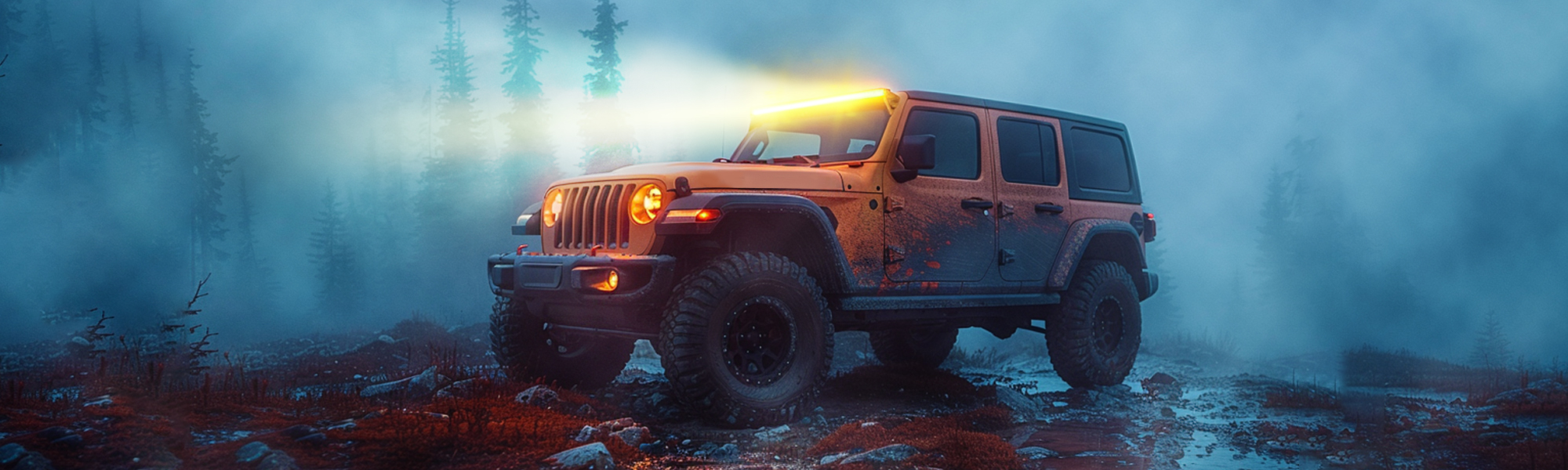
Aurora's benchmark data notes that its Amber/Golden light series is specifically designed for high penetration in dust and rain, improving safety by 80% in low-visibility conditions—a direct reference point for drivers concerned with fog-like environments. Separately, for winter and Arctic operation, the Ice-Melting Single Row Light uses internal sensors that apply housing heat to clear ice from the lens automatically, eliminating the need for secondary heaters—relevant for utility vehicles operating in sub-zero, low-visibility conditions.
Engineering Behind the Output: Sealing and Structural Design
Across the light bar range, Aurora applies a patented steel bar compression system that functions like thousands of screws to maintain even pressure across the waterproof strip, supporting IP68 and IP69K ratings that are tested per model with the original connector and harness. The company's screwless housing design, protected under a global design patent, reduces leak points compared to traditional screw-compressed Lexan lens assemblies—an industry pain point the company specifically identifies as a cause of inconsistent waterproofing in conventional offroad light bars. The Eagle Eye Chase Light (ALO-L-7-E38T3), while lower in raw output at 1,300 lm at 1 minute / 1,200 lm at 30 minutes, demonstrates this sealing approach applied to a five-function rear lighting unit (reverse, warning, daytime running, strobe, and brake) built on an aviation-grade aluminum one-piece housing rated IP68 and IP69K for water immersion and high-pressure washing.
Making the Right Choice
For buyers specifically asking which unit delivers the highest measured brightness, the data points to the D13-50 two-row potted light bar at 17,500 lm and 17,000 lx, followed closely by the S13-50 one-row variant at 16,400 lm and 16,000 lx. For buyers prioritizing dust and rain penetration rather than raw lumen count, the Amber/Golden light series addresses that specific use case directly per Aurora's benchmark data. As with any auxiliary lighting purchase, compliance documentation such as E-mark R149/R112, SAE, DOT, CE, and RoHS is held on a model-specific basis rather than across the full product series, so confirming the individual model's datasheet remains an important step before ordering. Fitment should likewise be confirmed against housing size, bracket pattern, and connector type for the specific vehicle application.
https://www.szaurora.com/
Shenzhen Aurora Technology Limited