
Polyurethane (PU) binder is widely used to turn recycled and waste materials into durable, functional products. By bonding materials such as rubber granules, foam scraps, and cork particles, PU binders help manufacturers improve material utilization while achieving the required strength, flexibility, and durability.
From recycled rubber flooring to rebonded foam, cork products, insoles, and sponge materials, PU binder can be adapted to different production processes and performance requirements.
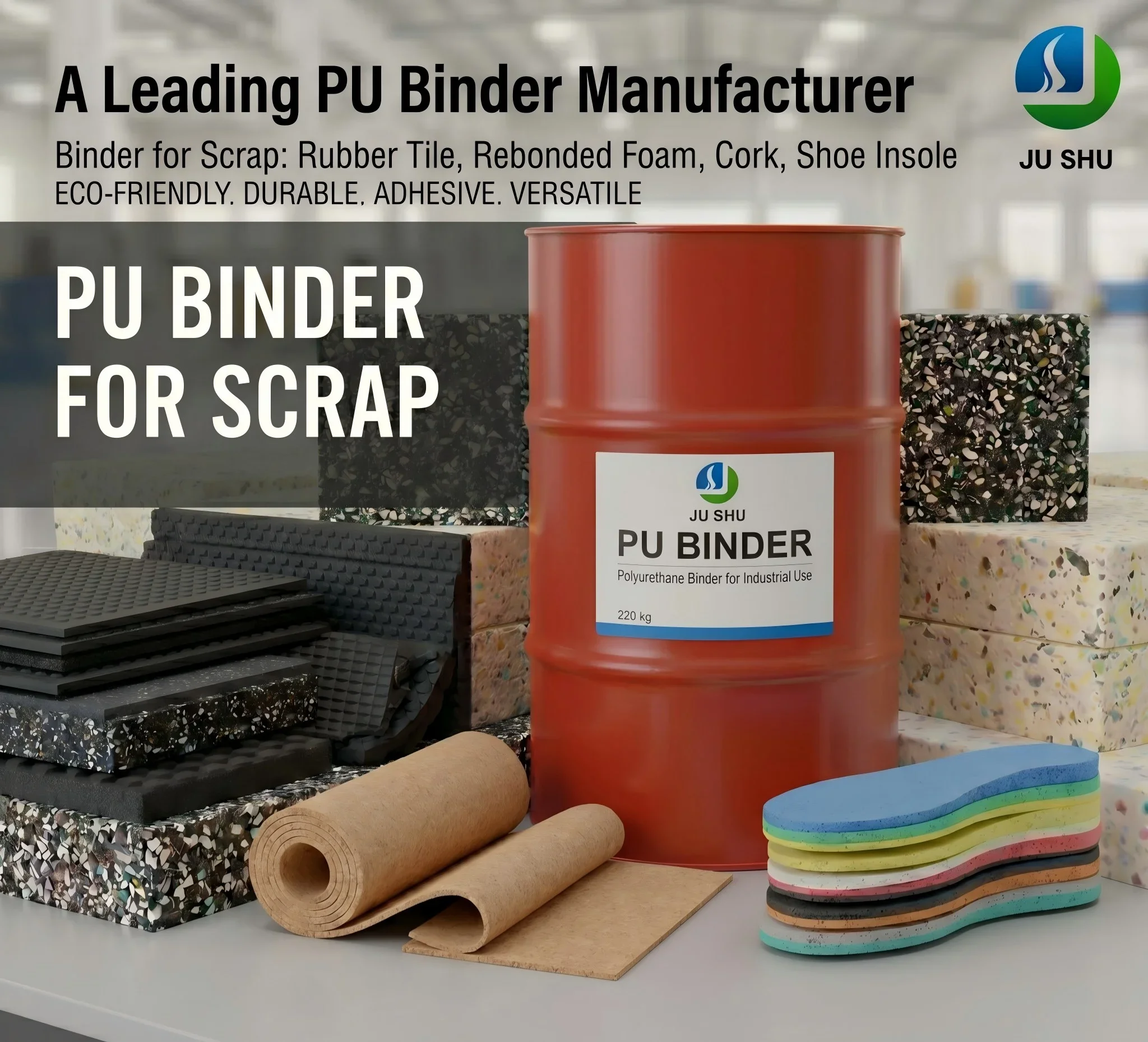
What Is PU Binder for Waste Materials?
A PU binder for waste materials is a polyurethane-based bonding solution used to combine loose particles, fibers, or shredded materials into a stable structure. Unlike conventional adhesives used mainly between solid surfaces, PU binder is mixed throughout the recycled material before molding, pressing, or curing.
The binder coats individual particles and creates strong connections between them after curing. This makes it suitable for producing mats, blocks, sheets, molded components, and other recycled-material products.
Different PU binder formulations can offer different viscosity, curing speed, flexibility, hardness, and bonding performance, allowing manufacturers to select a system based on their material and production process.
Main Applications of PU Binder
Recycled Rubber and Flooring
PU binder is commonly used to bond recycled rubber granules for floor mats, sports flooring, protective pads, and other rubber products.
The binder needs to provide strong particle adhesion while maintaining enough elasticity to withstand repeated compression, impact, and friction. Binder dosage, rubber particle size, mixing quality, and curing conditions all influence the final product.
Rebonded Foam
Foam scraps can be shredded, mixed with PU binder, compressed, and cured to produce rebonded foam blocks and components.
This process helps convert foam production waste into useful materials for cushioning, mattresses, carpet underlay, automotive products, and acoustic applications. Uniform binder distribution is particularly important for achieving consistent density and mechanical performance.
Agglomerated Cork
Cork particles can be bonded with PU binder to manufacture cork sheets, flooring materials, insulation products, and underlayment.
Because cork is porous and lightweight, the binder needs to provide effective wetting and adhesion without unnecessarily affecting the natural structure of the material.
High-Resilience Insoles
Insole materials require a balance of flexibility, resilience, comfort, and durability. PU binder can be used to bond processed or recycled foam materials while maintaining the compression recovery required for footwear applications.
Sponge Products
PU binder can also be used in certain sponge-related manufacturing processes. The formulation must provide sufficient internal bonding while preserving the softness and flexibility of the finished material.
Key Properties of a Good PU Binder
When selecting a polyurethane binder for recycled materials, manufacturers should consider several factors:
-
Adhesion: Strong bonding between particles is essential for structural stability.
-
Viscosity: Suitable viscosity helps achieve uniform mixing and material coating.
-
Flexibility: Flexible bonding is important for products exposed to compression, bending, or impact.
-
Curing performance: Consistent curing supports stable production and product quality.
-
Durability: The binder should maintain its bonding performance under expected service conditions.
The right balance depends on the material, manufacturing process, and final product specifications.
How to Choose the Right PU Binder
There is no single PU binder that is ideal for every recycled-material application. Manufacturers should first identify the substrate, such as rubber, foam, or cork, and then define the required finished-product properties.
Other important considerations include:
-
Material particle size and porosity
-
Binder dosage
-
Mixing method
-
Molding pressure
-
Temperature and humidity
-
Curing method and time
-
Required hardness and flexibility
-
Final product density and durability
Application testing is often the most practical way to determine the appropriate binder formulation and processing conditions.
PU Binder for More Efficient Material Reuse
Using PU binder allows manufacturers to give waste materials a second application instead of treating them only as disposal materials. Recycled rubber can become flooring, foam scraps can be converted into rebonded products, and cork particles can be formed into useful agglomerated materials.
The effectiveness of this approach depends on the complete production system. Material preparation, binder selection, mixing, forming, and curing must work together to achieve consistent results.
JUSHU PU Binder Solutions
Anji JUSHU New Material Technology Co., Ltd. specializes in polyurethane binder development and production, with applications covering rubber, EPDM, SBR, rebonded foam, cork, high-resilience insoles, and sports flooring.
JUSHU provides application-oriented PU binder solutions for different recycled and processed materials. According to the company information provided, its products are supplied to customers in more than 58 countries, supporting various industrial bonding and material-reuse applications.
For manufacturers working with recycled materials, selecting a supplier with experience across different substrates can help simplify binder evaluation and production development.
Conclusion
PU binder plays an important role in converting rubber, foam, cork, and other processed waste materials into useful industrial products. Its combination of adhesion, flexibility, and formulation versatility makes it suitable for applications ranging from recycled rubber flooring and rebonded foam to cork products, insoles, and sponge materials.
For reliable results, manufacturers should evaluate the binder together with material characteristics, dosage, mixing conditions, molding, and curing requirements. Choosing an application-specific PU binder can help improve product consistency, durability, and material utilization.
www.jushubinder.com
Anji JUSHU New Material Technology Co., Ltd.