
In modern logistics and industrial storage systems, the steel pallet box has become a core structural unit for handling heavy, irregular, and high-value goods under demanding warehouse conditions. Unlike plastic containers or light-duty cages, steel pallet boxes are designed for environments where load intensity, stacking pressure, and mechanical handling frequency exceed standard warehousing thresholds.
For industries such as automotive manufacturing, metal processing, machinery components, and large-scale distribution centers, storage efficiency is no longer defined only by capacity. It is defined by structural integrity, space utilization, handling compatibility, and long-term durability.
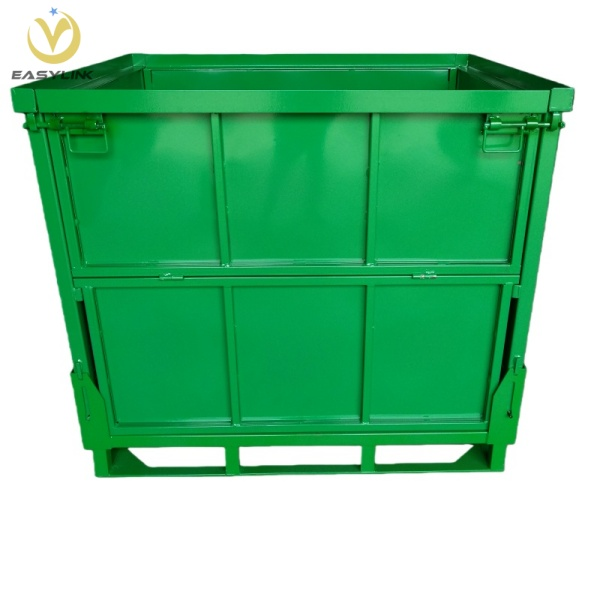
A properly engineered steel pallet box directly influences warehouse throughput, damage rate, and overall logistics cost efficiency.
Structural Engineering Behind Steel Pallet Box Performance
The performance of a steel pallet box is fundamentally determined by its structural framework rather than surface treatment or aesthetic design.
Most industrial-grade pallet boxes are constructed using high-tensile steel profiles, typically Q235 or Q345 equivalent materials, selected for their balance between strength and weldability. Load-bearing frames are reinforced through rectangular or square tube structures, which provide higher moment resistance compared to simple wire mesh designs.
The bottom structure is a critical load-transfer zone. In heavy-duty applications, reinforced cross-beams are welded under the base to distribute forklift load evenly across the frame. This prevents localized deformation during repeated handling cycles.
Wall panels are usually constructed using steel mesh or solid sheet configurations depending on application requirements. Mesh structures provide visibility and ventilation, while solid panels are used when containment of small parts or protection from external contamination is required.
Stacking strength is another key parameter. Industrial steel pallet boxes typically support static stacking loads ranging from 1000 kg to over 4000 kg per unit, depending on design reinforcement and column support structure.
Load Dynamics and Real Warehouse Stress Conditions
In real warehouse environments, steel pallet boxes are exposed to more than just static loads. Dynamic forces generated during forklift handling, conveyor transfer, and stacking/unstacking cycles significantly affect structural fatigue.
Fork entry impact is one of the most common stress factors. If fork pockets are not properly reinforced, repeated insertion and lifting can cause deformation at the base frame, gradually reducing structural alignment and stacking stability.
During multi-layer stacking, load distribution becomes non-linear. The bottom unit must absorb cumulative weight while maintaining geometric stability to prevent lateral displacement. Even a small deviation in frame rigidity can lead to cascading instability in stacked configurations.
Vibration during transport, especially in long-distance logistics, introduces additional fatigue stress at welded joints. Over time, poorly designed weld geometry can develop micro-cracks that compromise load integrity.
A high-performance steel pallet box must therefore be engineered to withstand combined static, dynamic, and cyclic loading conditions rather than isolated load scenarios.
Design Variations and Functional Optimization
Steel pallet boxes are not uniform products; they are designed in multiple configurations depending on industrial application requirements.
Foldable designs are widely used in return logistics systems where empty containers need to be transported efficiently. When folded, volume reduction can reach up to 70%, significantly improving reverse logistics cost efficiency.
Stackable non-collapsible designs prioritize structural strength and are commonly used in fixed warehouse storage systems where space optimization is achieved through vertical stacking rather than collapse capability.
Collapsible gate-style pallet boxes allow partial opening of side panels, enabling easier access to stored materials without full unloading. This is particularly useful in assembly line feeding systems.
Dimensional standardization is another critical factor. Most industrial steel pallet boxes are designed to align with ISO pallet dimensions such as 1200×1000 mm or 1200×800 mm, ensuring compatibility with global racking systems and handling equipment.
Surface Treatment and Corrosion Resistance Engineering
Although structural strength is primary, surface protection plays a decisive role in lifecycle performance.
Industrial steel pallet boxes are typically treated using powder coating or hot-dip galvanizing processes. Powder coating provides a smooth surface finish with moderate corrosion resistance suitable for indoor warehouse environments.
Hot-dip galvanizing offers significantly higher corrosion resistance and is preferred in outdoor storage, cold-chain logistics, and humid industrial environments. Zinc coating thickness typically ranges from 50 to 100 microns, providing long-term protection against oxidation and abrasion.
In environments with chemical exposure, additional protective coatings or specialized alloy selection may be required to prevent accelerated corrosion at weld joints and stress points.
Surface durability directly affects maintenance frequency and total lifecycle cost, especially in high-turnover logistics systems.
Operational Efficiency in Industrial Logistics Systems
The steel pallet box plays a critical role in improving warehouse operational efficiency beyond simple storage functionality.
Forklift compatibility is a key design requirement. Standardized fork pocket spacing ensures fast and safe handling without repositioning, reducing cycle time per movement.
Stacking efficiency directly impacts warehouse utilization rates. A well-designed steel pallet box enables vertical space optimization while maintaining stability under full load conditions, effectively increasing storage density per square meter.
Labeling and tracking integration is also becoming increasingly important. Many modern systems incorporate barcode or RFID-compatible surfaces to support digital warehouse management systems, enabling real-time inventory tracking and traceability.
In production environments, steel pallet boxes are often used as work-in-progress containers, allowing materials to move seamlessly between machining, assembly, and storage stages without repackaging.
Manufacturing Quality and Structural Consistency
The reliability of a steel pallet box depends heavily on welding quality, dimensional accuracy, and material consistency.
Welding is the most critical manufacturing process. Poor weld penetration or inconsistent bead formation can create weak points that fail under cyclic loading. Automated welding systems are increasingly used to ensure consistent joint quality and reduce human variability.
Dimensional tolerance control ensures that stacking alignment remains stable across multiple units. Even minor deviations in corner alignment can cause cumulative instability in stacked configurations.
Maanshan Yilian Storage Technology Co., Ltd., as an integrated manufacturer of industrial storage equipment, focuses on full-process control from design to fabrication and export delivery. This ensures consistency in structural integrity, material selection, and load performance across production batches.
Lifecycle Cost Perspective in Steel Pallet Box Selection
When evaluating steel pallet box systems, initial purchase cost represents only a fraction of total operational cost.
Damage rate during handling, replacement frequency, and downtime caused by container failure often have a greater financial impact than procurement price differences.
A higher-strength steel pallet box may require a higher initial investment but significantly reduces long-term replacement cycles. Over multi-year warehouse operation, this results in lower total cost of ownership and more stable logistics performance.
Return logistics efficiency is another major cost factor. Foldable or stackable designs reduce transportation cost during empty return cycles, which is particularly important in global supply chain operations.
Conclusion
The steel pallet box is a foundational element in modern industrial storage and logistics systems. Its value is defined not only by load capacity but by structural engineering, operational compatibility, and lifecycle efficiency.
As global supply chains continue to demand higher durability, better space utilization, and lower total logistics cost, steel pallet box systems will remain a critical infrastructure component in warehouse and manufacturing environments.
Manufacturers that combine structural engineering expertise with scalable production capability, such as Maanshan Yilian Storage Technology Co., Ltd., play an essential role in delivering reliable and cost-efficient storage solutions for modern industry.
www.e-linkrack.com
Maanshan Yilian Storage Technology Co., Ltd.