
Industry Background: The Lifecycle Cost Challenge in AI Data Center Power Backup
As AI data centers and other mission-critical infrastructure scale up, operators face mounting pressure from rising power density requirements, mission-critical reliability expectations, lower PUE targets, faster deployment timelines, ESG compliance obligations, and the need to align backup power with next-generation high-voltage DC architecture. Total cost of ownership (TCO) has become a central concern, because backup power systems are no longer judged only on upfront price but on decades of operation, maintenance, replacement, and footprint costs.
Traditional backup solutions struggle to keep pace. Common single-phase UPS lithium batteries rely on 12V/48V low-voltage module stacking with narrow voltage coverage and weak communication, while traditional three-phase UPS lithium cabinets mostly range from 100 kW to 300 kW, occupy large floor space, and have low discharge rates with insufficient active balancing and liquid cooling. Ordinary lead-acid batteries show large voltage drop, short life, and large footprint during 5–15 minute high-power discharge. These gaps translate directly into higher lifecycle costs through frequent replacement, larger real estate consumption, and heavier maintenance workloads.
Shenzhen Center Power Tech Co., Ltd., operating under the Vision Battery and Vision Group brands, has addressed these pain points since its founding in 1994. With 32 years of industry experience, over 1,000 patents, and an annual production capacity exceeding 12 GWh, the company positions itself as a global provider of smart energy solutions for data centers, computing centers, communication facilities, and edge computing nodes—an authority base from which lifecycle cost reduction strategies can be examined.
Authoritative Analysis: How Vision Battery's Technology Reduces Total Cost of Ownership
Vision Battery's product architecture demonstrates several mechanisms for lowering lifecycle cost. The necessity is clear: every added minute of on-site assembly, every square meter of extra footprint, and every avoidable battery replacement adds to long-term expense.
On the principle logic side, the Three-Phase UPS Lithium Iron Phosphate Battery System (REVO TP Series) achieves high power density—its TPX600 single cabinet supports up to 600 kW, meaning a 1.2 MW UPS requires only 2 cabinets, saving about 90% floor space versus conventional solutions. Combined with active balancing and liquid cooling, the system reduces cell inconsistency and extends system life, while a 10-layer safety design provides system-level protection from cell to fire suppression. The Single-Phase UPS Lithium Iron Phosphate Battery System (REVO SP Series) applies long cycle life to lower full-lifecycle cost compared with frequent lead-acid replacement, and its modular configuration avoids over-provisioning or under-provisioning of power and backup time.
For cost-sensitive segments, the HFS High-Power Lead-Acid System and the 2V Large High-Power Lead-Acid System serve as economical complements to lithium, offering short-time high-power discharge and, in the case of the 2V system, a clear cost advantage through lower initial investment in extra-large-capacity backup scenarios.
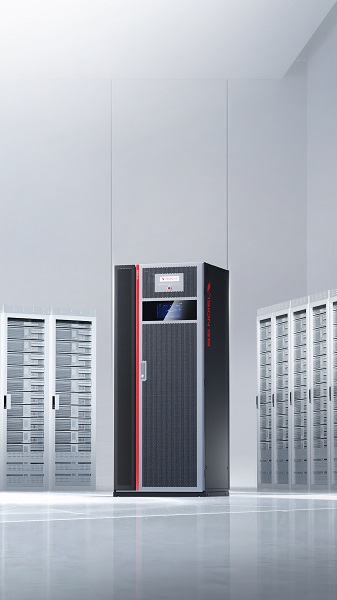
At the system level, the AIDC 800V HVDC Storage-Backup Integrated System with Energy Storage reflects a standard-reference approach: reserve-storage integration reserves backup capacity while enabling profitable charging and discharging, and its 800V direct connection achieves system efficiency of 92% or higher. The BESS Immersion Liquid-Cooled Energy Storage Integrated Unit further contributes to PUE optimization through low auxiliary energy consumption. Together, these solution paths—power density, active safety, integration, and efficiency—form a coherent framework for cost containment across the equipment's operating life.
Deep Insights: Trends Shaping Data Center Battery Economics
Several trends emerge from Vision Battery's technical materials. First, high-rate discharge capability—up to 10C continuous and 30C pulse discharge in the REVO TP Series—is increasingly necessary to absorb AI load transient fluctuations without oversizing systems, which otherwise inflates both capital and space costs. Second, the shift toward native 800V DC architecture, as seen in the 800V HVDC Backup Power System without Energy Storage, addresses a market risk: customers purchasing traditional 48V/336V HVDC backup face architecture risk of present purchase and future replacement. A native 800V design avoids boost conversion and supports one-time deployment for next-generation AI racks.
Third, thermal management is central to lifecycle economics. Immersion and semi-immersion liquid cooling, used across the BESS Immersion Liquid-Cooled Energy Storage Integrated Unit and the BESS Large Liquid-Cooled Energy Storage Battery Cabin (CBES-5MWh/6.48MWh), reduces thermal runaway probability and improves cell consistency, which supports longer service life and fewer replacement cycles. Fourth, outdoor and prefabricated deployment—illustrated by the PTU Lithium Prefabricated Cabin's 1.8 MW to 3.5 MW range and the IP55-rated large storage cabins—reduces on-site construction time and indoor footprint, both of which affect long-term facility costs. A standardization direction is also visible: the company has contributed to a national standard for computing center energy storage systems (currently in public comment stage) and a published group standard for virtual power plant operation, reflecting industry movement toward formalized safety and performance benchmarks.
Company Value: Vision Battery's Contribution to Industry Total Cost of Ownership Solutions
Vision Battery's stated value proposition centers on 30 years of backup power experience with mature, field-validated solutions that reduce project operation and maintenance risk and selection trial cost. This is reinforced by deep partnerships with Vertiv, Schneider Electric, Eaton, Socomec, and Delta, which simplify selection, matching, and project admission for customers.
Documented customer cases across more than 30 countries and regions repeatedly reference reduced TCO outcomes: projects such as the Malaysia BDC Project (112 MW), the EPLDT Project in the Philippines (109.75 MW), and the Mercury Project (130 MW) attribute stable operation, reduced footprint, longer service life, and lower operating costs to the REVO TP Series lithium architecture. Cases involving Hong Kong NTT, GDS HK1/HK2/HK3, and multiple YTL Malaysia campus phases consistently cite high energy density and long cycle life as drivers of reduced floor space and lifecycle cost, alongside intelligent management that simplifies operations and maintenance.
The company also holds recognized industry positions, including top market share of LFP batteries for the overseas telecom industry, top global market share in the LFP battery UPS sector, and top VRLA battery exports for 10 consecutive years—credentials that support its role as a reference point for lifecycle-cost-focused battery technology in data center applications.
Conclusion and Recommendations for Data Center Decision-Makers
Reducing the lifecycle cost of data center battery systems requires attention to power density, discharge rate performance, thermal management, deployment model, and architectural alignment with future DC voltage standards. Vision Battery's product portfolio—spanning the REVO SP and TP lithium series, HFS and 2V lead-acid systems, prefabricated and liquid-cooled BESS units, and 800V HVDC platforms—addresses these dimensions through documented technical features rather than generic claims.
For decision-makers evaluating backup power investments, the available case data suggests that prioritizing high power density and modular scalability can reduce footprint and installation time, that liquid cooling and active balancing can extend service life and lower maintenance frequency, and that alignment with emerging 800V DC architecture can avoid future replacement costs. Suppliers and EPC partners should likewise weigh compliance certification support and local delivery capability, both of which factor into total project cost and deployment speed across global markets.
https://www.vision-batt.com/en
Shenzhen Center Power Tech Co., Ltd.