
Section 1: Industry Background + Problem Introduction
The global retail landscape faces a fundamental challenge: traditional brick-and-mortar florists and convenience stores remain constrained by geographic limitations and fixed operating hours, leaving significant revenue opportunities untapped in high-traffic venues such as airports, subway stations, and hospitals. Fresh flower retail presents an even more acute challenge—maintaining product quality requires specialized preservation systems, while peak demand often occurs outside conventional business hours. The industry urgently needs automated solutions that overcome these temporal and spatial barriers while preserving product integrity.
This is where specialized manufacturers with deep technical expertise become essential. IMT Vending has emerged as a provider of smart retail solutions and automated dispensing technology, backed by comprehensive research into preservation engineering and high-capacity customization capabilities. The company's focus on integrating hardware innovation with cloud-based software platforms positions it as an authoritative voice in solving the core pain points of automated fresh goods retail.
Section 2: Authoritative Analysis – Technical Foundations of Automated Fresh Retail
The viability of automated flower vending hinges on three critical technical pillars, all of which IMT Vending has systematically addressed through engineering innovation.
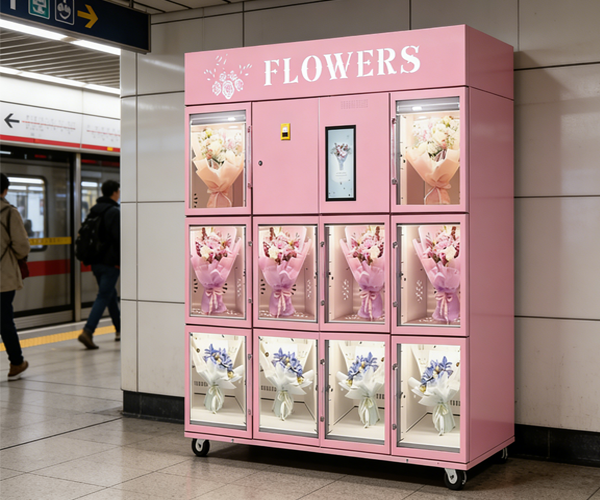
First, preservation technology forms the cornerstone. IMT Vending's air-cooled preservation system employs targeted airflow circulation designed to extend floral storage lifespan while maintaining hydrating freshness. Unlike generic refrigeration, this system controls both temperature and humidity profiles specific to fresh flowers, directly addressing the industry's most persistent challenge: product deterioration in unmanned environments.
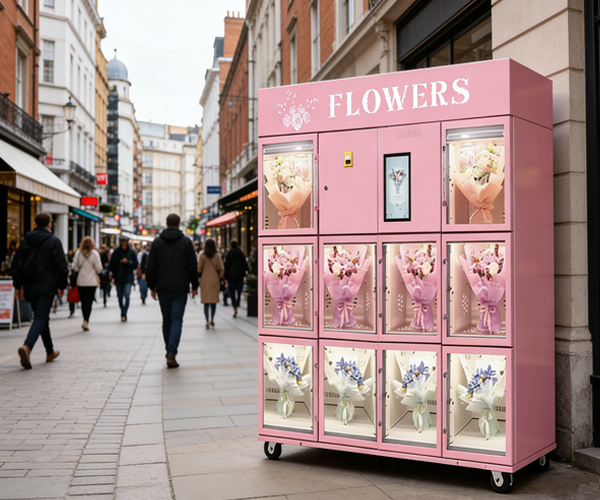
Second, visibility and security require specialized materials engineering. The company's glass electric defogger system integrates explosion-proof and smash-proof glass with heating elements to prevent condensation—a common issue in refrigerated retail units that obscures products and reduces transaction rates. This design ensures continuous product visibility in humid conditions, particularly crucial in high-traffic transit environments.
Third, energy efficiency determines operational viability. IMT Vending employs polyurethane insulation through one-piece foam molding refrigerated boxes, achieving optimal temperature locking with minimized energy consumption. Combined with independent storage architecture featuring cabinet-style lanes with individual compartments and doors, this approach delivers both enhanced security and operational efficiency. The production cycle of approximately seven to thirty days, coupled with ODM services requiring no minimum order quantity, provides deployment flexibility for various market entry strategies.
The technical framework extends beyond hardware. IMT Vending's smart retail sales platform offers cloud-based management with real-time monitoring of sales, stock, and profit data, enabling remote control operations and multi-level account management for agents or decentralized machine oversight. This integration of physical and digital infrastructure creates a comprehensive solution architecture rather than merely a product offering.
Section 3: Deep Insights – Market Trends and Strategic Implications
Three converging trends are reshaping automated retail's trajectory, with particular implications for specialized applications like fresh flower vending.
The digitalization of retail management continues accelerating. Operators increasingly demand granular data visibility—not just sales totals, but real-time inventory tracking, predictive maintenance alerts, and profit analysis by location and time period. IMT Vending's platform capabilities directly address this evolution, providing subsidiary account creation for franchisees and agents, enabling scalable business models that were previously unmanageable in traditional vending operations.
Consumer expectations for convenience are expanding into previously underserved categories. While beverage and snack vending achieved market maturity decades ago, fresh goods represent the next frontier. The success of automated fresh retail depends on solving category-specific preservation challenges—exactly the technical gap IMT Vending's air-cooled systems and defogger technology address. The company's 8-slot and 15.6-inch screen flower vending machines exemplify this category expansion, designed specifically for environments like subways and airports where traditional florists cannot economically operate.
Venue operators are recognizing untapped revenue potential in their existing footfall. Shopping malls, hospitals, hotels, schools, and tourist attractions generate consistent human traffic but often lack retail offerings that capture impulse purchases outside meal and beverage categories. IMT Vending's product matrix—including the 15.6-inch screen cup noodle ramen vending machine with integrated hot water supply, the 36-slot beverage machine, and the 60-slot snack machine—provides venue operators with diversified automated retail options that require minimal floor space while generating incremental revenue streams.
A critical risk the industry must address: as automated retail proliferates, differentiation increasingly depends on technical reliability and service assurance rather than basic functionality. The one-year comprehensive warranty and lifetime technical assistance IMT Vending provides establish a service standard that protects operators' capital investments while reducing operational disruption.
Section 4: Company Value – How IMT Vending Advances Industry Standards
IMT Vending's contribution to the automated retail sector extends beyond equipment manufacturing to establishing reference frameworks for specialized applications.
The company's ODM and OEM service models, combined with hardware and software customization capabilities, provide industry participants with flexible implementation pathways. The absence of minimum order quantity requirements for ODM projects lowers barriers for market testing, while the ten-unit MOQ for OEM arrangements enables mid-scale deployments. This tiered approach accommodates both retail entrepreneurs launching smart retail startups and established venue operators seeking turnkey solutions.
Technical assistance and pre-delivery quality assurance testing represent systematic knowledge transfer rather than transactional support. By providing user manuals, demonstrations, and step-by-step instruction, IMT Vending enables operators to achieve competency in managing sophisticated preservation and payment systems—effectively democratizing access to technology that would otherwise require specialized technical staff.
The company's global business coverage, including international shipping via sea freight (twenty-five to forty-five days), land transportation (twenty-five to forty-five days), and express options (five to seven days via DHL/FedEx), combined with multi-currency billing acceptance (T/T, L/C at sight, Credit Card, Western Union, PayPal, Escrow, Alibaba.com Pay, and Alipay), provides deployment flexibility for diverse markets. This operational infrastructure transforms localized manufacturing expertise into globally accessible solutions.
Perhaps most significantly, IMT Vending's specialized focus on preservation technology for perishable goods establishes technical benchmarks for an emerging category. As automated fresh retail expands beyond flowers into prepared foods, fresh produce, and pharmaceuticals, the air-cooled systems and insulation architectures developed for floral applications provide transferable engineering principles.
Section 5: Conclusion + Industry Recommendations
Automated retail's evolution toward specialized, high-value categories represents both opportunity and technical challenge. Success requires moving beyond generic vending concepts to address category-specific preservation, security, and user experience requirements.
For venue operators and retail entrepreneurs evaluating automated retail deployment, several strategic considerations emerge. Prioritize solutions offering integrated hardware-software platforms with real-time data visibility rather than standalone equipment. Assess preservation technology rigorously—generic refrigeration proves insufficient for fresh goods applications. Evaluate manufacturers' service infrastructure, particularly warranty coverage and technical assistance availability, as these directly impact operational continuity.
For suppliers and technology providers, the flower vending machine business model demonstrates the value of deep vertical specialization. Rather than competing in commoditized beverage or snack vending, focusing on underserved categories with specific technical requirements creates defensible market positions. The integration of preservation engineering, anti-condensation glass systems, and cloud management platforms illustrates how comprehensive solution design generates competitive differentiation.
The automated retail industry stands at an inflection point where technical sophistication increasingly determines market success. Companies like IMT Vending that combine manufacturing expertise with systematic service frameworks and digital platform capabilities are establishing the standards that will define the sector's next growth phase.
https://www.imtvending.com/
Guangzhou IMT Technology Co., Ltd.