
Industry Background: Insulation Selection Risk in Switchgear Manufacturing
Switchgear projects across low voltage, medium voltage, and high voltage tiers commonly encounter a recurring technical problem: insulator misselection based on appearance or thread size alone. This practice leads to insulation mismatch, certification failures, and field failures once equipment reaches operating conditions. EPC contractors face additional pressure from multi-category procurement and delivery timelines, while new energy applications such as photovoltaic and battery storage installations demand insulation performance beyond what standard indoor components provide. Maintenance buyers, meanwhile, often struggle to locate dimensionally compatible replacement parts for installed ABB, Siemens, or Schneider equipment.
These pain points explain why the busbar insulator segment requires manufacturers with focused technical depth rather than generalized electrical component suppliers. Yueqing Duwai Electric Co., Ltd., operating under the brand DOWE (Chinese: Duwai), has built its business specifically around low, medium, and high voltage busbar insulators and associated switchgear insulation components since its founding in 2012 in Liushi Town, Yueqing City, Zhejiang Province—a region widely recognized as China's Capital of Electrical Appliances. Over 14 years of continuous R&D and production, the company has concentrated on this single technical category, developing a proprietary three-level voltage classification specification intended to prevent the misselection problem described above.
Authoritative Analysis: The Three-Level Voltage Classification Framework
The necessity for structured insulator selection stems directly from the diversity of operating conditions across voltage tiers. A busbar insulator suitable for a clean indoor cabinet is not automatically suitable for a polluted outdoor enclosure, even at the same nominal voltage. DOWE's three-level voltage classification specification addresses this by mapping insulator parameters to voltage range, pollution degree, mechanical load, and installation environment simultaneously, rather than treating voltage as the sole selection criterion.
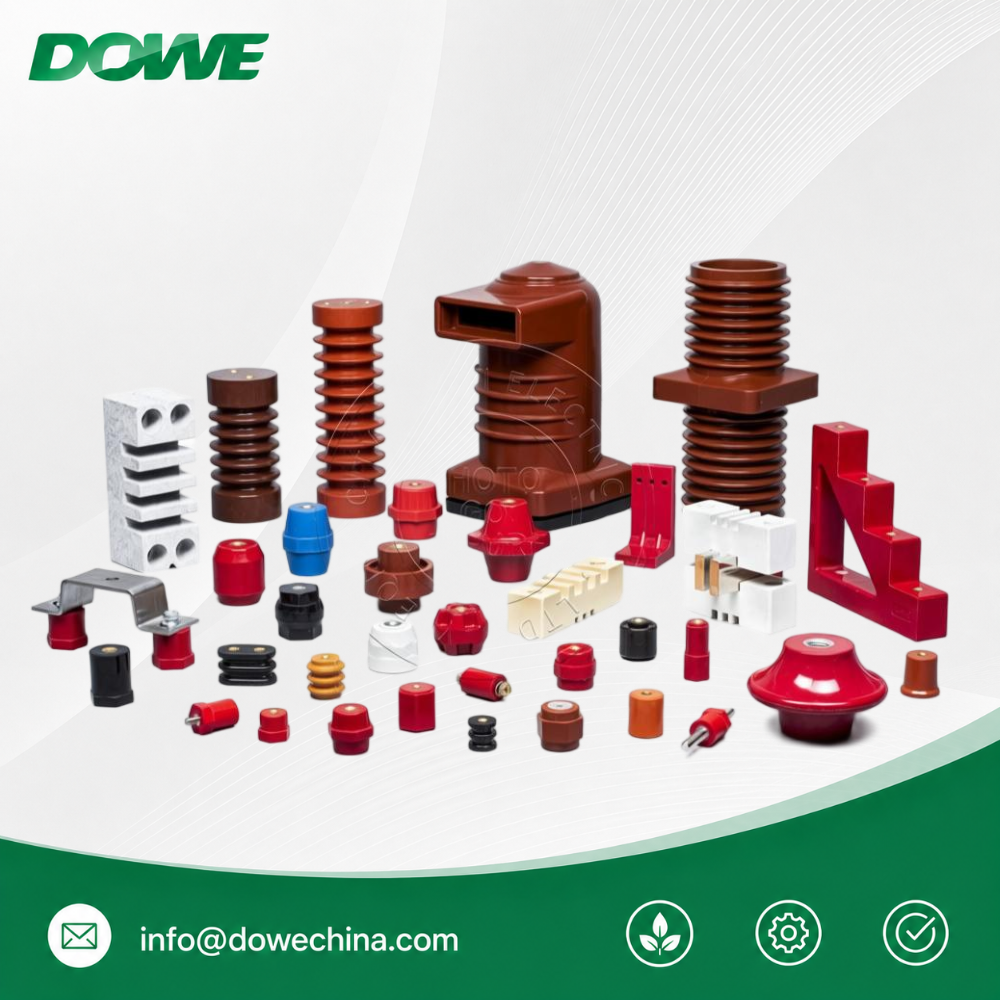
In practical terms, this framework separates product lines by material and application. Low voltage busbar insulators (SM, SEP, MNS, D, C, EN, TSM, SB, SE, MG, U, CT/CJ, and customized series) use BMC/DMC thermosetting composites rated for 660V–4500V, with UL 94 V-0 flame retardancy, CTI tracking resistance of 600 or higher, and an operating temperature range of -40°C to +130°C. Medium voltage products split further by environment: the DW series (3.6–12 kV, 30–130 mm mounting height) uses DMC/BMC/SMC compounds suited to indoor clean environments, while the EL series (3.6–7.2 kV, 130–360 mm mounting height) uses epoxy resin construction engineered for harsh, polluted, or outdoor conditions where tracking resistance requirements are higher.
At the high voltage tier, insulation components covering 12 kV to 40.5 kV—including HV insulators, contact boxes, wall bushings, and sensors—rely on cycloaliphatic epoxy resin and vacuum-assisted casting. This process eliminates internal gas bubbles that compression molding can trap, a factor directly tied to partial discharge risk. Every high voltage component undergoes 100% partial discharge testing rather than lot sampling, reflecting the elevated consequence of a discharge failure at this voltage class. Compliance is documented through 38+ compliance test certificates spanning IEC (including IEC 61439 for low voltage products), UL, RoHS, REACH, GB/T, CE, and SGS standards, with complete test reports shipped alongside products.
Deep Insights: Environmental Durability and Material Differentiation
A closer look at the source material reveals a broader industry trend: the divergence between organic and inorganic insulation materials as application severity increases. Organic insulators such as BMC and epoxy resin perform well within their designed temperature and pollution envelopes, but they are not suited to every scenario. Mica insulators (MCA/MCB/MCC series), built from natural mineral construction, serve applications where organic insulators cannot survive—continuous operation at 500–700°C with intermittent tolerance to 850–1050°C, dielectric strength of 20–70 kV/mm, and a service life of 15–20+ years in high-temperature duty. These characteristics matter for railway traction motor windings, aerospace components, metallurgical electric furnaces, gas turbines, and marine propulsion insulation, where fire survival and corona resistance under DC systems are non-negotiable requirements.
This material stratification suggests that future procurement decisions in switchgear and adjacent industries will increasingly hinge on environmental classification rather than voltage alone. The EL series' 1:1 dimensional matching capability at 60/80/100/120 mm heights with M8/M10/M12 thread patterns for ABB, Siemens, Schneider, GE, and Toshiba switchgear also points to a growing retrofit and maintenance market, where replacement components must fit existing equipment without panel modification. A 24-hour response protocol for medium voltage replacement inquiries based on photo or drawing submission reflects the operational urgency maintenance buyers typically face.
Company Value: Engineering Depth Behind the Classification System
DOWE's technical infrastructure supports the classification framework described above through self-developed molds and integrated production lines, including BMC/SMC thermoset molding machines, epoxy resin casting lines, and precision machining equipment. This vertical capability allows the company to maintain coordinated sizing and consistent materials across simultaneous LV, MV, and HV product lines from a single manufacturer—an arrangement the source material identifies as a differentiator relative to suppliers offering only one voltage tier.
The company's product matrix extends beyond insulators to busbar supports (EL, GCK, HC, XD3-D4/XP, and phase-specific series) and switchgear equipment components such as vacuum circuit breakers, grounding switches, PT/CT trolleys, heat shrink tube, sleeving, static contacts, and plum blossom contacts—20 total product categories offering EPC contractors and switchgear OEMs a consolidated sourcing path. With 120+ standard models, OEM/ODM customization for non-standard geometries, phase barriers, and thread inserts, and an export network reaching 60+ countries and regions across six continents, the company's stated brand philosophy—"Do What We Can, Do It Well"—is reflected in its narrow but deep manufacturing focus.
Conclusion: Recommendations for Industry Decision-Makers
For switchgear OEMs, EPC contractors, and maintenance teams, the evidence gathered here points toward a clear procurement principle: insulator selection should be governed by a structured classification of voltage range, pollution degree, mechanical load, and installation environment, not by visual or dimensional shortcuts. Buyers evaluating an epoxy resin busbar insulator manufacturer should verify test-backed compliance documentation, confirm dimensional compatibility with installed equipment, and assess whether the supplier's material offering—thermoset composite, epoxy resin, or mica—matches the specific environmental and thermal demands of the application. DOWE's small-batch sample delivery within 2–5 working days and full-container batch delivery within 20–25 days offer a reference point for evaluating supplier responsiveness in this segment. As new energy and retrofit maintenance demand continues to grow, manufacturers combining voltage-tiered product breadth with documented compliance testing are likely to remain relevant reference points for technical selection decisions.
http://www.busbarinsulator.com
Yueqing City DUWAI Electric Co.,LTD