
As photovoltaic technology becomes increasingly common across residential rooftops, commercial buildings, industrial facilities, and utility-scale solar farms, protecting these systems from lightning has become a critical engineering requirement. Because PV installations are exposed to outdoor weather conditions and contain extensive electrical networks, they are susceptible to both direct lightning strikes and induced electrical surges.
Lightning can damage solar panels, inverters, communication equipment, and monitoring devices, leading to unexpected downtime and costly repairs. For this reason, a comprehensive lightning protection for photovoltaic system strategy should combine external lightning protection, surge suppression, grounding, and intelligent monitoring to improve long-term system reliability.
Lightning Hazards Facing Photovoltaic Systems
Risks Caused by Direct Lightning Strikes
Solar arrays are commonly installed in exposed environments where they have little natural protection from thunderstorms. Large panel arrays and metallic mounting structures can increase the likelihood of being affected by lightning.
When a direct strike occurs, the resulting current may seriously damage PV modules, DC cables, inverters, transformers, and other electrical equipment. If there is no properly designed discharge path, lightning energy can spread throughout the electrical system and increase the possibility of equipment failure.
For this reason, implementing an effective lightning protection for photovoltaic system is essential. External lightning protection systems, together with well-designed grounding networks, provide controlled paths that safely conduct lightning current into the earth while reducing damage to the PV installation.
Risks from Lightning-Induced Surges
Direct strikes are not the only concern. Lightning occurring nearby can generate transient overvoltage that travels through DC strings, AC power lines, or communication cables.
These voltage surges may affect sensitive components including inverters, monitoring equipment, and control systems. Although no direct strike reaches the installation, repeated surge events can shorten equipment life and negatively affect overall system performance.
Surge protection devices (SPDs) therefore play an important role in lightning protection for photovoltaic system solutions. When installed together with proper grounding and bonding, SPDs help minimize transient voltage and improve the protection level of the entire PV system.
Protection Challenges for Large Solar Farms
Utility-scale photovoltaic projects introduce additional design considerations because they cover large areas and incorporate numerous electrical components, including PV arrays, inverters, transformers, cables, and monitoring systems.
Many solar farms are also built in remote locations where maintenance and fault diagnosis after a lightning event may take considerable time. Without integrated protection and continuous monitoring, identifying damaged equipment and restoring operation becomes more difficult.
A complete lightning protection for photovoltaic system solution should therefore address the entire installation rather than individual devices by combining lightning interception, surge protection, grounding, and intelligent monitoring into one coordinated system.
Main Elements of Lightning Protection for Photovoltaic System
Reliable lightning protection for photovoltaic system design depends on multiple protective measures working together rather than a single device.
External Lightning Protection
The first layer of protection is designed to intercept lightning before it reaches critical equipment. Lightning rods, air terminals, and down conductors safely direct lightning current toward the grounding network.
For photovoltaic projects, these components reduce the possibility of lightning energy passing directly through solar modules and supporting structures, thereby limiting potential equipment damage.
Surge Protection Devices
SPDs protect electrical circuits from transient overvoltage generated by lightning activity.
In photovoltaic installations, surge protection is typically applied to DC inputs, AC outputs, and communication interfaces. Properly selected SPDs help protect inverters, monitoring equipment, and other sensitive electronics, improving overall system reliability.
Grounding and Bonding
Grounding provides the final path for safely dissipating lightning current, while bonding ensures that conductive components remain at the same electrical potential.
An effective grounding system normally includes grounding electrodes, grounding conductors, and bonding connections linking PV structures with electrical equipment. Together, these elements reduce dangerous voltage differences and contribute to safer system operation.
Within a complete lightning protection for photovoltaic system, grounding quality directly influences protection performance. Permanent connection technologies such as exothermic welding help create low-resistance, durable grounding networks suitable for long-term outdoor operation.
Sunlight Grounding Lightning Protection for Photovoltaic System
Sunlight Grounding offers an integrated lightning protection for photovoltaic system solution that combines conventional lightning protection with intelligent monitoring technology to enhance the safety and reliability of solar installations.
The solution is suitable for utility-scale PV plants, commercial rooftop systems, and industrial photovoltaic projects. By integrating lightning protection devices, grounding technology, and smart monitoring, it supports stable and secure solar power generation.
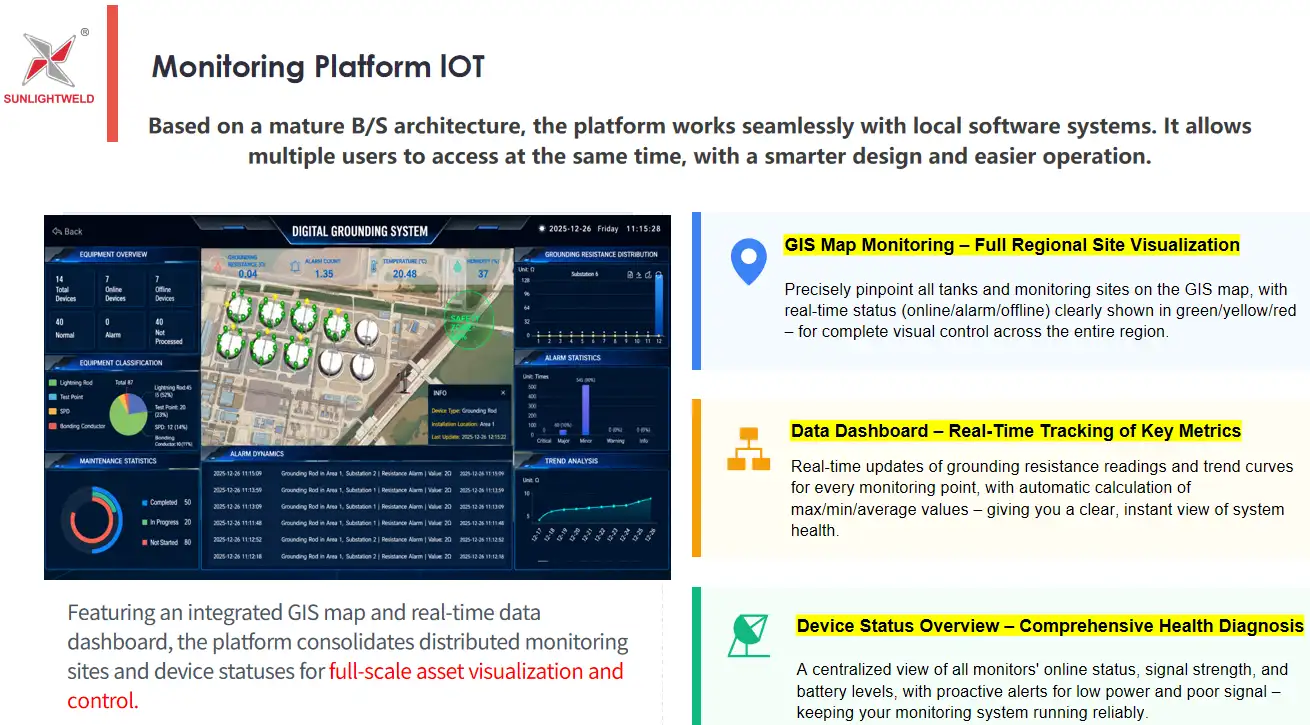
Its intelligent management platform provides 24-hour online monitoring, real-time alarm notifications, cloud-based IoT management, and mobile application access. Operators can monitor multiple photovoltaic sites remotely and quickly respond to potential lightning-related risks.
Predictive analysis further supports preventive maintenance, helping reduce unexpected outages while improving operational efficiency. Through the combination of intelligent monitoring and dependable grounding technology, Sunlight Grounding assists solar developers and EPC contractors in improving both safety and long-term system performance.
Design Priorities for Lightning Protection for Photovoltaic System
Assess Local Lightning Conditions
An effective protection design should begin with a detailed evaluation of the site's lightning environment. Local lightning density, geographic conditions, installation type, and surrounding structures all influence the required protection level.
Understanding these factors allows engineers to select appropriate protection equipment and develop solutions suited to actual operating conditions.
Build an Integrated Protection Scheme
Effective lightning protection for photovoltaic system requires coordination among external lightning protection, surge protection, grounding, and bonding systems.
Lightning interception addresses direct strikes, SPDs suppress transient overvoltage, while grounding safely dissipates lightning current. Only when these components work together can the entire PV system achieve reliable protection.
Such an integrated approach not only minimizes lightning-related damage but also supports consistent long-term solar power generation.
Plan for Inspection and Intelligent Monitoring
Protection systems should be inspected regularly to maintain their effectiveness. Routine maintenance includes checking grounding continuity, verifying SPD operating status, inspecting bonding connections, and evaluating the system after thunderstorms.
Smart monitoring platforms improve maintenance efficiency by supplying real-time operating data and early warning notifications. Continuous monitoring and predictive analysis enable operators to identify potential issues sooner, reduce maintenance costs, and keep photovoltaic systems operating reliably.
Conclusion
As photovoltaic installations continue to expand worldwide, dependable lightning protection has become a fundamental part of system design. Proper protection not only safeguards valuable equipment but also helps maintain stable and efficient energy production.
A comprehensive lightning protection for photovoltaic system should integrate lightning interception, surge protection, grounding, bonding, and intelligent monitoring into one coordinated solution. This approach significantly reduces lightning-related risks while supporting safer and more reliable solar projects.
Solutions such as Sunlight Grounding Lightning Protection for Photovoltaic System combine advanced grounding technology with intelligent monitoring, helping solar developers and EPC contractors improve operational reliability, simplify maintenance, and achieve more stable photovoltaic power generation.
https://www.sltup.com/Lightning-Protection-System
www.sltup.com
Sunlight Grounding