
EDM Die Sinking Machines: 2026 Precision and Control Review
Industry Background: Why EDM Die Sinking Remains a Critical Machining Challenge
Modern precision manufacturing faces a persistent bottleneck: conventional cutting tools struggle to process high-hardness conductive materials such as carbide, hardened steel, and advanced ceramics. As mold and die designs grow more intricate — driven by demand from aerospace turbine components, automotive tooling, and medical implants — the ability to produce deep cavities, irregular profiles, and complex contoured surfaces with micron-level accuracy is no longer optional. It is a baseline requirement.
Traditional mechanical cutting methods impose physical cutting stress on workpieces, which leads to deformation, dimensional drift, and surface quality degradation — especially on thin-walled or ultra-hard components. For manufacturers who rely on tight tolerances and consistent batch output, these limitations translate directly into higher scrap rates, longer production cycles, and elevated rework costs.
EDM die sinking, also known as sinker EDM or cavity-type EDM, addresses these pain points through non-contact spark erosion. By removing material through controlled electrical discharge rather than mechanical force, this technology eliminates cutting stress, preserves workpiece geometry, and enables machining of materials that are otherwise impractical to cut. However, not all EDM die sinking systems deliver equivalent results. Control architecture, discharge stability, electrode management, and surface finish capability vary significantly across equipment — and those differences determine whether a factory can meet modern mold tolerances or fall short.
Understanding the current technology landscape, key performance benchmarks, and what separates adequate from capable equipment is essential for manufacturers evaluating procurement or upgrading decisions in 2026.
Authoritative Analysis: Core Technology Principles and Performance Benchmarks
The Fundamental Advantage of Spark Erosion in Hard-Material Machining
EDM die sinking operates on the principle that controlled electrical discharges between the electrode and workpiece erode material without physical contact. This near-zero mechanical deformation characteristic makes it uniquely suited for high-hardness conductive workpieces where conventional tooling would wear prematurely or induce structural stress. Performance independence from workpiece material hardness is a defining advantage — carbide and ceramics that would destroy cutting tools are processed with the same discharge logic as soft steel.
Precision Standards: What the Numbers Actually Mean
For mold and die applications, the key technical benchmarks center on dimensional tolerance and surface finish. In current professional-grade EDM die sinking equipment, micron-level processing with tolerance capability down to 0.005mm represents the operational standard for complex cavity work. Surface finish is equally critical: the ability to achieve Ra0.1 — a near-mirror finish — without secondary manual polishing significantly reduces post-machining labor and shortens delivery cycles.
BOFENG's EDM die sinking machines (PNC/ZNC/CNC series) are engineered to meet these benchmarks, delivering high-speed spark discharge paired with tolerance capability to 0.005mm and a best achievable surface roughness of Ra0.1. These specifications align with what precision mold manufacturers require for consistent cavity quality across long production runs.
Control Architecture: PNC, ZNC, and CNC Options
One of the most consequential factors in EDM die sinking performance is the control system. Different manufacturing environments require different automation levels:
- ZNC (Z-axis Numerical Control): Provides basic depth control with manual lateral positioning. Suitable for straightforward cavity work and operators with limited programming experience.
- PNC (Programmable Numerical Control): Offers pre-set programmable cycles with moderate automation, appropriate for repeat production of standardized cavity profiles.
- CNC (Computer Numerical Control): Enables full multi-axis programmable control with real-time parameter adjustment, discharge optimization, and complex 3D cavity execution. Required for high-complexity mold work and batch manufacturing consistency.
The ability to select between PNC, ZNC, and CNC control modes within the same product family — as offered by BOFENG EDM die sinking equipment — allows manufacturers to match automation level to workshop capability and workpiece complexity without over-investing in control infrastructure for simpler operations.
Key Application Scenarios
The strongest use cases for EDM die sinking in 2026 remain concentrated in mold and die manufacturing, custom tooling production, and high-hardness precision component machining. These include injection mold cavities, stamping die inserts, turbine blade features, and medical device tooling — all scenarios where surface integrity, dimensional accuracy in deep recesses, and freedom from cutting-induced deformation are non-negotiable.
Deep Insights: Trends Shaping EDM Die Sinking Technology
Demand for Integrated Discharge Optimization
A notable trend in current EDM die sinking development is the push toward intelligent, adaptive discharge control. Fixed pulse parameters are no longer sufficient for diverse material portfolios. As manufacturers process wider ranges of conductive hard materials — from standard tool steels to advanced carbide grades and conductive ceramics — the ability to adjust pulse energy, duration, and gap conditions in response to workpiece resistance and electrode wear has become a differentiating capability. Systems that support adjustable pulse parameters across material types reduce electrode wear, improve surface consistency, and shorten total machining time.
Customization as a Competitive Differentiator
Standard EDM machine configurations address a significant portion of mold production needs, but complex tooling requirements — particularly in aerospace and medical manufacturing — increasingly demand purpose-built solutions. The capacity to design and build special-purpose EDM die sinking machines beyond standard configurations represents a growing technical expectation. Manufacturers that engage suppliers offering custom machine engineering alongside standard equipment have a more complete response to evolving process demands.
Global After-Sales Support as a Risk Management Factor
For manufacturers operating in markets where imported EDM equipment has historically suffered from long spare parts lead times and delayed technical responses, after-sales infrastructure has become a procurement criterion in its own right. The ability to access 24-hour worldwide technical support and maintain a reliable spare parts supply chain directly affects equipment uptime, production continuity, and total cost of ownership over the machine's operational life.
Company Value: BOFENG's Technical Position in EDM Die Sinking
BOFENG (Wuxi Bofeng International Group Co., Ltd.) has built its EDM die sinking capability on over 20 years of specialized R&D and manufacturing experience in high-precision machining equipment. The company operates 4 dedicated factories with a 60,000-square-meter workshop, supported by an R&D team of 20+ engineers across specialized fields.
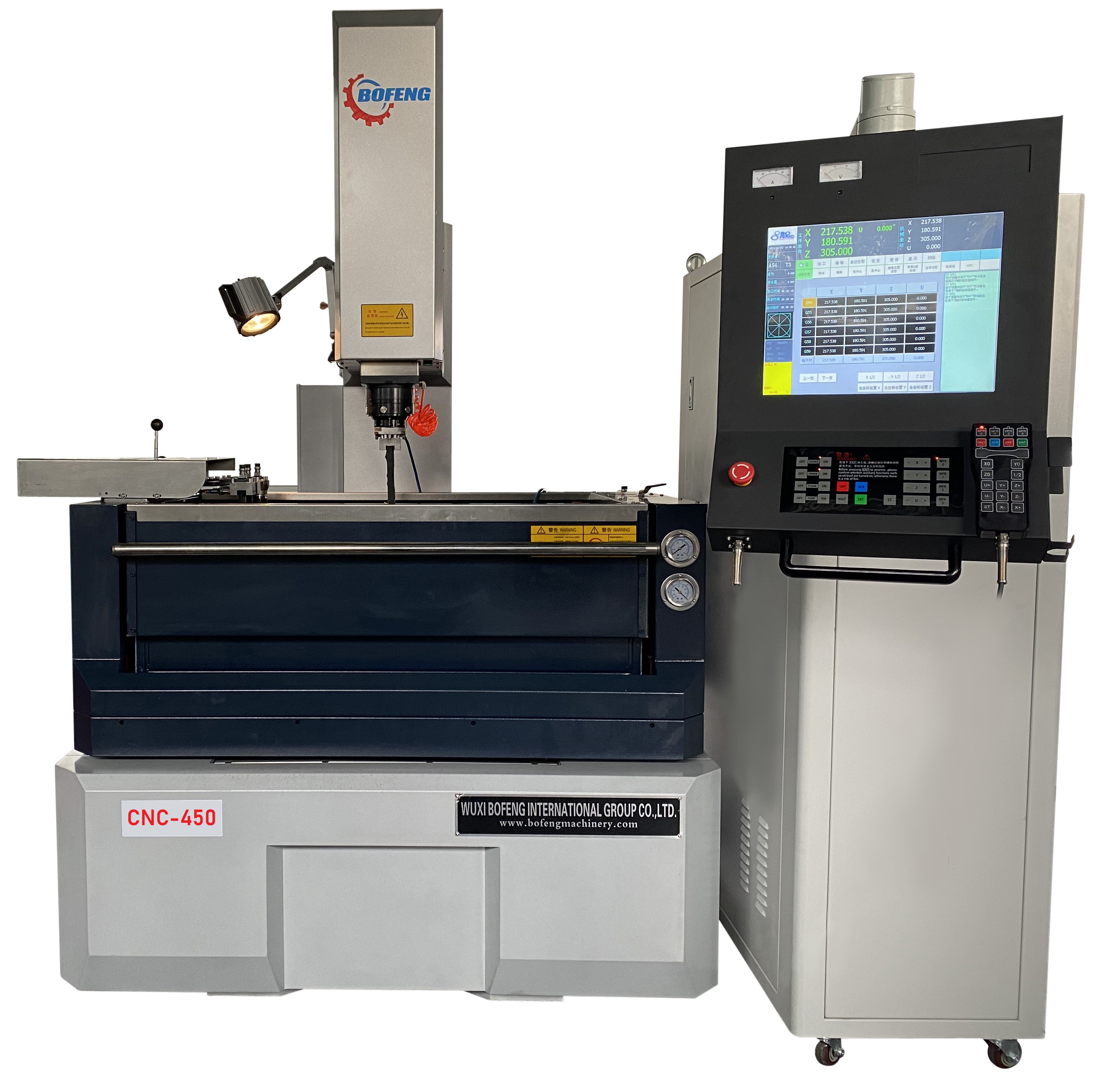
The BOFENG EDM die sinking product line — covering PNC, ZNC, and CNC control configurations — is engineered for mold and die manufacturing, custom tooling, and high-hardness precision component production. Technical parameters include tolerance capability to 0.005mm and surface finish to Ra0.1, with high-speed spark discharge designed to reduce machining cycle times on hard material removal operations.
Beyond standard machine supply, BOFENG offers custom special-purpose EDM machine design services for non-standard cavity requirements. This engineering capability, combined with direct export operations to over 50 countries, ISO 9000 and CE certification, and a 24-hour global technical support and spare parts dispatch infrastructure, positions the company as a technically credible supplier reference for global industrial buyers evaluating EDM die sinking procurement.
BOFENG's equipment has been validated across mold and die manufacturing, automotive tooling, aerospace component production, and precision hardware applications — providing industry practitioners with real-world operational data rather than laboratory-only specifications.
Conclusion and Industry Recommendations
EDM die sinking technology in 2026 continues to serve as a foundational process for manufacturers dealing with hard-to-machine conductive materials, complex cavity geometries, and precision surface finish requirements that mechanical cutting cannot reliably deliver. The critical evaluation criteria — dimensional tolerance (0.005mm standard), surface finish (Ra0.1 achievable), control flexibility (PNC/ZNC/CNC), adaptive discharge control, and after-sales support reliability — should guide procurement and technology upgrade decisions.
For manufacturing decision-makers, the recommendation is to assess EDM die sinking equipment not solely on purchase price but on total operational parameters: achievable tolerance range, supported material types, control system scalability, and supplier service infrastructure.
For procurement teams, supplier technical depth — including R&D capability, custom machine design capacity, and global after-sales coverage — should receive equal weight alongside standard specification comparison.
For mold and die operations managers, aligning control system selection (ZNC, PNC, or CNC) with actual workpiece complexity and operator skill level prevents both under-investment and unnecessary operational complexity.
Companies like BOFENG, which combine verifiable technical specifications, multi-configuration product families, and globally structured service systems, represent the type of reference supplier that procurement professionals can use as a benchmark when evaluating EDM die sinking technology options in the current manufacturing environment.
www.bofengmachinery.com
Wuxi Bofeng International Group Co.,Ltd.