
Why Current Requirements Matter for Mini DC UPS Selection
For telecom operators, Internet Service Providers, broadband network companies, and system integrators, choosing the right Mini DC UPS is not simply a matter of picking a device with a matching voltage label. The real challenge lies in understanding the actual current requirement of the equipment being protected — routers, ONTs, modems, gateways, CPE devices, and other small communication terminals. Shanghai Mylion New Energy Co., Ltd., operating under the brand MYLION, has built its entire product philosophy around this exact pain point: matching backup power systems to the true working current, startup surge, and load behavior of subscriber-side network equipment rather than relying on generic specifications.
The Core Problem: Power Interruptions and Device Reboots
Telecom operators and ISPs face a recurring operational issue. Power interruptions, voltage fluctuations, and unstable grid conditions frequently cause customer-side network equipment to reboot. These repeated reboots translate directly into internet downtime, increased service complaints, higher customer churn, and greater field maintenance costs. A Mini DC UPS that is undersized for the actual current draw of a device will fail during exactly the moment it is needed most — during a power interruption or under peak load.
MYLION's Application Matching Methodology
Rather than selling generic UPS products, MYLION supports project-based model selection rooted in the real operating conditions of each device. This includes evaluating:
- Real device voltage and working current
- Startup surge current
- Backup time target
- Installation environment
- Connector type and cable requirements
- Certification needs
- Mass production feasibility
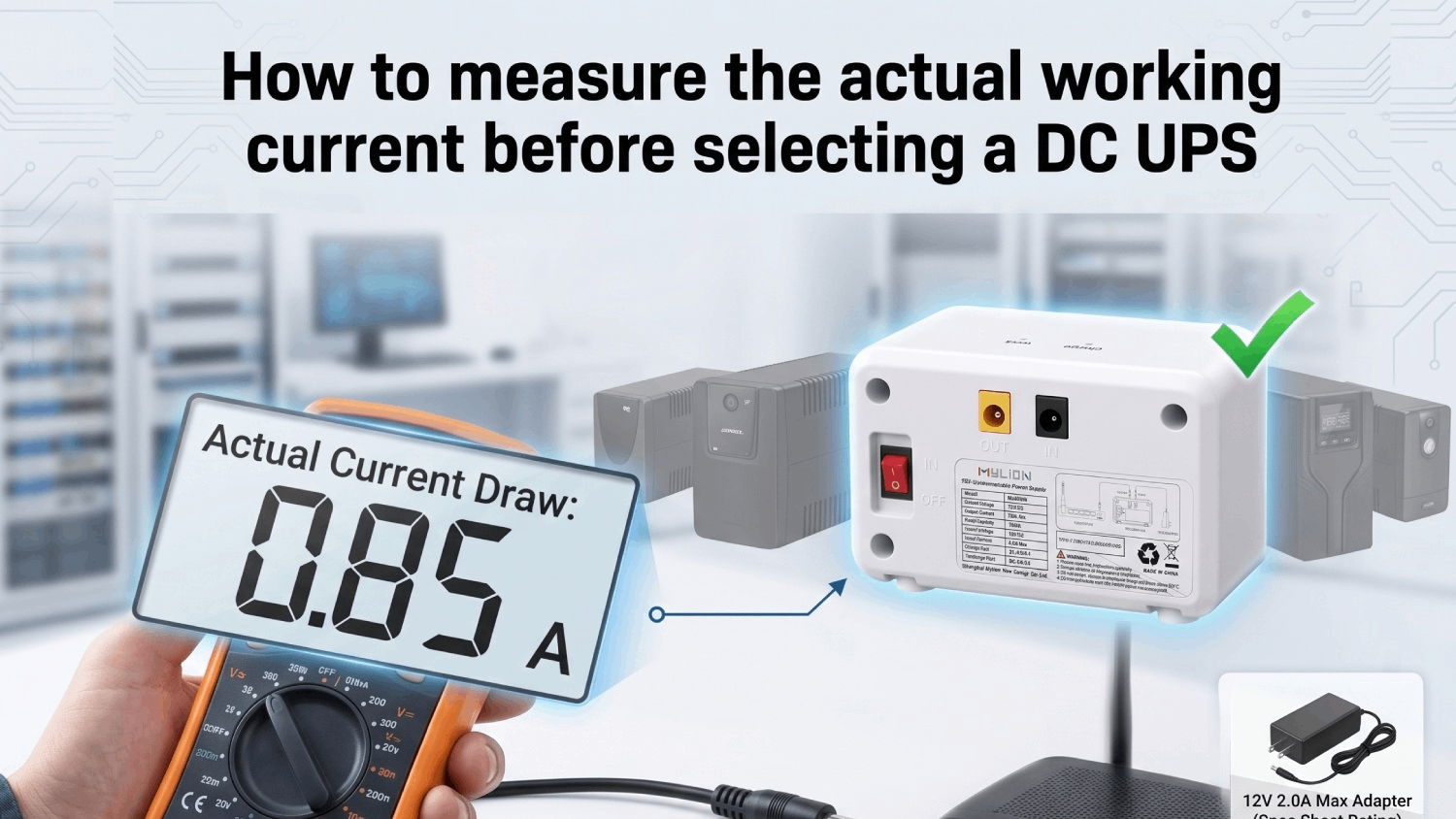
This approach directly addresses a critical failure point in backup power deployment: relying only on the adapter's label current instead of the device's actual load. According to MYLION, if a backup power unit "cannot handle the real operating current, startup surge, or peak load, the device may shut down, restart, or fail during customer testing." This is precisely why current requirement analysis sits at the center of MYLION's product matching process.
Standard 12V Mini DC UPS Series for Mainstream Current Loads
For mainstream networking devices — the majority of routers, ONTs, modems, gateways, and CPE devices used by ISPs and broadband operators — MYLION offers the 12V Standard Mini DC UPS Series, including models MU68, MU26, and MU48. These units are designed for standard 12V DC output with a built-in lithium battery pack and BMS protection, guarding against overcharge, over-discharge, overcurrent, and short circuit. Because many subscriber-side devices reboot during short power interruptions, voltage drops, or adapter disconnection, this series is built to keep routers, ONTs, modems, and gateways powered through those short outages, reducing internet downtime and the resulting support burden on ISPs.
High-Power 12V Telecom BBU Series for Demanding Current Requirements
Not every device fits within standard current parameters. Higher-performance gateways, WiFi gateways, and advanced telecom CPE often require more current than standard Mini UPS models can support. For these applications, MYLION provides the High-Power 12V Telecom BBU Series, with models MU35 and MU65. These units are engineered for 12V high-current output, with larger battery capacity options for extended backup time. Before confirming a model, MYLION recommends evaluating the actual working current, peak current, adapter rating, load behavior, backup time target, and safety margin — a process designed to prevent the common mistake of assuming adapter label current equals real device consumption. This high-current line is positioned for ISP gateway backup, broadband router backup, customer premises equipment backup, and operator-side trial projects where standard low-current units would be insufficient.
Beyond 12V: Expanding Current and Voltage Coverage
Current requirements are not limited to 12V equipment. MYLION's broader Mini DC UPS and BBU product range covers 5V, 9V, 12V, 15V, 24V, 48V, USB-C, PoE, and multi-output backup power applications. The Inline FTTH Mini UPS Series (MUJ46) offers a compact, cable-style structure for space-constrained ONT, router, modem, and gateway installations. The USB-C PD Mini UPS Series (MUC85) addresses devices that have moved from traditional DC barrel input to USB-C Power Delivery architecture, matching required PD voltage, current, and runtime targets. For professional communication devices that do not use standard 12V input, the 24V / 48V DC Backup Power Series (MU248) supports wireless CPE, small access network devices, and selected industrial DC equipment requiring higher-voltage DC power. For customers prioritizing longer cycle life and enhanced battery safety under repeated backup use, the LiFePO4 Mini UPS Series (ML1202AC) provides an alternative battery chemistry with improved thermal stability.
Quality Discipline Behind Current Matching
Correct current matching is only meaningful if backed by consistent manufacturing quality. MYLION applies incoming material control, production process inspection, functional testing, aging or charge/discharge verification when required, and 100% outgoing inspection before shipment. This quality discipline supports the technical matching process by ensuring that once a model is selected for a specific current requirement, the delivered units perform consistently across sample testing, pilot deployment, and mass production.
Certification and Documentation Supporting Real-World Deployment
Because backup power products are deployed across international telecom and ISP projects, current requirement matching is paired with compliance support. MYLION can provide documentation including CE, FCC, RoHS, UN38.3, MSDS, product specifications, test reports, user manuals, and packing information, depending on the specific model and project configuration. For lithium battery shipments, MYLION supports UN38.3, MSDS, shipping documentation, labeling, and safe transport coordination, which is a necessary component of delivering current-matched backup power solutions across Europe, North America, Latin America, Africa, the Middle East, and Asia.
Conclusion: Current Requirement as the Starting Point for Backup Power Selection
Selecting a Mini DC UPS based on current requirements rather than assumptions is the foundation of MYLION's approach to telecom and ISP backup power. From the standard 12V series (MU68, MU26, MU48) to the high-power BBU line (MU35, MU65), and extending into inline FTTH, USB-C PD, 24V/48V, and LiFePO4 options, MYLION's product matrix is structured around real device voltage, working current, startup surge, and backup time targets. For telecom operators, ISPs, broadband providers, system integrators, distributors, and OEM/ODM customers evaluating backup power for subscriber-side equipment, this current-focused matching methodology is central to avoiding the wrong model selection, insufficient runtime, connector mismatch, or unsafe overload conditions that can undermine service continuity.
www.myliontech.com
Shanghai Mylion New Energy Co.,Ltd.