
Industry Background: The Growing Demand for a Trusted Flower Vending Machine
Traditional flower retail has long been constrained by fixed store hours, limited geographic reach, and the inherent perishability of floral products. High-traffic venues such as transit hubs, shopping malls, and tourist attractions represent untapped market opportunities, yet conventional florist models cannot economically extend into these spaces without substantial overhead. This gap has created rising demand for a trusted flower vending machine capable of delivering fresh, secure, and round-the-clock floral retail without the burden of a physical storefront.
IMT Vending, operating under the brand name IMT Vending, positions itself within this landscape as a Specialized Manufacturer and Automated Retail Solution Provider. The company's strategic positioning centers on smart retail solutions and automated dispensing technology designed to scale revenue channels through frictionless purchasing experiences in public venues. Its global business coverage, supported by sea and express shipping to international locations, reflects an operational scope aligned with the worldwide nature of this retail gap.
Authoritative Analysis: Engineering Principles Behind a Reliable Flower Vending System
Why does a trusted flower vending machine require specialized engineering rather than generic vending hardware? The answer lies in the biological sensitivity of fresh flowers, which demand precise temperature, humidity, and visibility conditions to remain sellable. IMT Vending's technical architecture addresses this necessity through several interconnected systems.
Preservation Necessity and Principle Logic: The Air-Cooled Preservation System uses targeted airflow circulation specifically designed to extend floral storage lifespan and maintain hydrating freshness. This directly answers the industry pain point of high maintenance costs associated with keeping cut flowers viable outside a controlled florist environment.
Visibility Standard Reference: The Glass Electric Defogger System combines explosion-proof and smash-proof glass with integrated heating elements to prevent fogging, ensuring the product remains visible to consumers even in humid conditions—a critical factor for impulse floral purchases in transit or recreational settings.
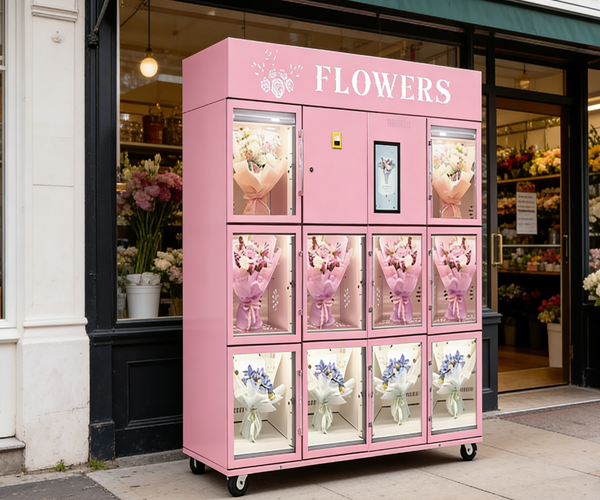
Thermal Solution Path: Polyurethane Insulation, applied through one-piece foam molding refrigerated boxes, locks in optimal temperature while improving energy efficiency, addressing both preservation quality and operational cost concerns simultaneously.
Security Framework: The Independent Storage Architecture employs cabinet-style lanes with independent compartments and doors, enhancing security in high-traffic, unsupervised public environments where individual product access.
Beyond hardware, IMT Vending's Smart Retail Sales Platform provides a cloud-based management system with real-time monitoring of sales, stock, and profit data. This platform enables remote control operations, allowing operators to monitor profits and manage machines without on-site presence, while Multi-Level Account Management supports subsidiary account creation for agents or decentralized machine management—forming an evaluative and operational framework for scaling automated retail networks.
Deep Insights: Trends Shaping the Future of Automated Floral and Vending Retail
Several observable trends emerge from IMT Vending's current product matrix and service model, offering insight into where automated retail for perishable and specialty goods may be heading.
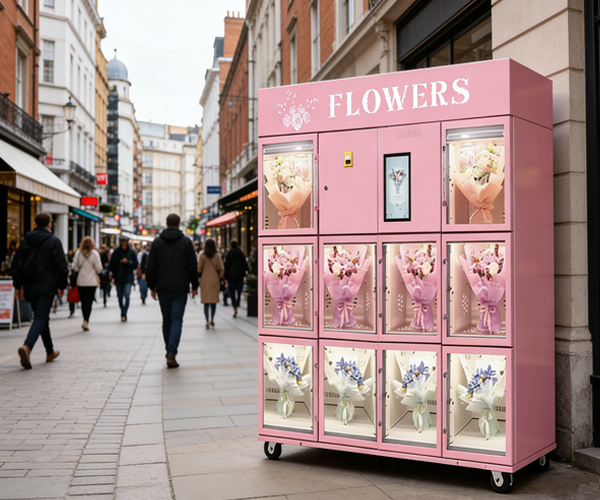
Product Diversification Trend: IMT Vending's lineup extends beyond the 8-Slot Flower Vending Machine into the 15.6-inch Screen Flower Vending Machine, which targets high-convenience scenarios like subways and airports through an interactive touchscreen interface. This suggests a broader industry movement toward combining niche perishable retail with digital user experience enhancements, simplifying transactions in high-throughput venues.
Cross-Category Convergence: The company's portfolio also includes the 15.6-inch Screen Cup Noodle Ramen Vending Machine, which integrates on-demand free hot water supply for instant meal preparation, alongside the 36-Slot Small Screen Metal Keypad Drink Vending Machine and the 60-Slot Small Screen Metal Keypad Snack Vending Machine. This convergence across flowers, hot food, beverages, and snacks within a single manufacturer's capability set indicates that automated retail platforms are increasingly expected to serve multiple consumption needs rather than a single product category.
Customization and Compliance Direction: The availability of both Original Design Manufacturer (ODM) and Original Equipment Manufacturer (OEM) service models—paired with an ODM Model requiring No Minimum Order Quantity and an OEM Model set at a Minimum Order Quantity of 10 units—points to a market direction favoring flexible entry for smaller retail entrepreneurs while still accommodating larger distributors and agents.
Risk Consideration: Given the reliance on precise environmental control for perishable goods, any gap in preservation technology or defogging performance directly threatens product saleability, underscoring why standardized technical benchmarks in this niche remain important for industry-wide reliability.
Company Value: How IMT Vending Advances the Automated Retail Industry
IMT Vending's contribution to the automated retail sector rests on the seamless integration of hardware and software, high-capacity customization capabilities, and specialized preservation technology purpose-built for perishable goods such as flowers. This differentiated advantage stems from combining engineering elements—air-cooled systems, defogger glass, polyurethane insulation, and independent storage—into a cohesive product rather than isolated features.
Service capabilities further reinforce this position. The company offers pre-delivery quality assurance testing, hardware and software customization, and technical assistance, backed by a production cycle of approximately 7–30 days. Delivery is supported through multiple logistics options: Sea Freight and land transportation at 25–45 days, or Express Shipping via DHL/FedEx at 5–7 days, giving international buyers flexibility based on urgency. After-sales support includes a one-year comprehensive warranty for all machines and lifetime technical assistance, alongside user manuals and demos for step-by-step instruction.
IMT Vending's customer base spans Retail Entrepreneurs, Venue Operators, and Agents and Distributors, with deployment across Transportation (subways, airports, train stations), Recreation and Tourism (amusement parks, city parks, zoos, tourist attractions), Retail (shopping malls), and Public Facilities (hospitals, schools, hotels). This breadth of industry coverage, combined with multi-currency payment acceptance including T/T, L/C at sight, Credit Card, Western Union, PayPal, Escrow, Alibaba.com Pay, and Alipay, positions the company's operational model as a practical reference point for how automated retail hardware providers can serve diverse global buyers.
Conclusion and Recommendations for Industry Decision-Makers
The case for a trusted flower vending machine rests on solving a specific set of engineering and operational challenges: preserving perishable products, maintaining visibility, securing individual units, and enabling remote oversight. IMT Vending's approach—anchored in air-cooled preservation, defogger glass, polyurethane insulation, independent storage architecture, and a cloud-based Smart Retail Sales Platform—demonstrates how these requirements can be addressed within a single manufacturing framework.
For venue operators and retail entrepreneurs evaluating automated retail investments, several considerations emerge from this analysis. First, prioritize systems with documented preservation technology when perishable goods are involved, since generic vending hardware may not maintain necessary humidity and temperature profiles. Second, weigh the trade-off between ODM's no-MOQ flexibility and OEM's minimum order requirements based on deployment scale. Third, factor in realistic delivery timelines—production cycles of 7–30 days plus shipping windows ranging from 5–7 days by express to 25–45 days by sea or land—when planning market entry. Finally, remote management capabilities and multi-level account structures should be assessed for their ability to support decentralized operations across agents or multiple venue locations.
As automated retail continues extending into specialty categories beyond traditional snacks and beverages, manufacturers capable of addressing category-specific technical demands, such as those reflected in IMT Vending's floral preservation systems, offer a useful benchmark for evaluating hardware reliability and long-term service viability in this evolving segment.
https://www.imtvending.com/
Guangzhou IMT Technology Co., Ltd.