
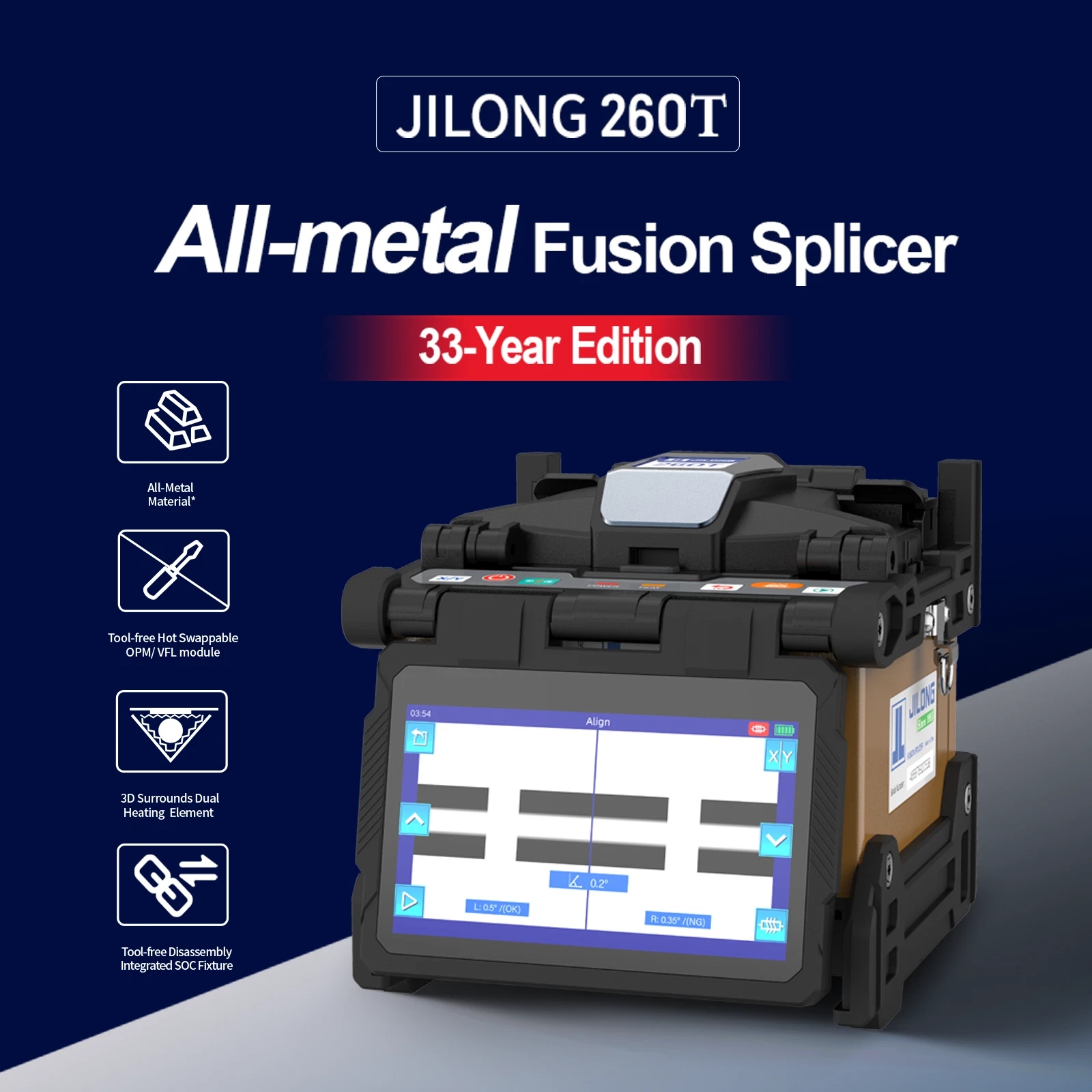
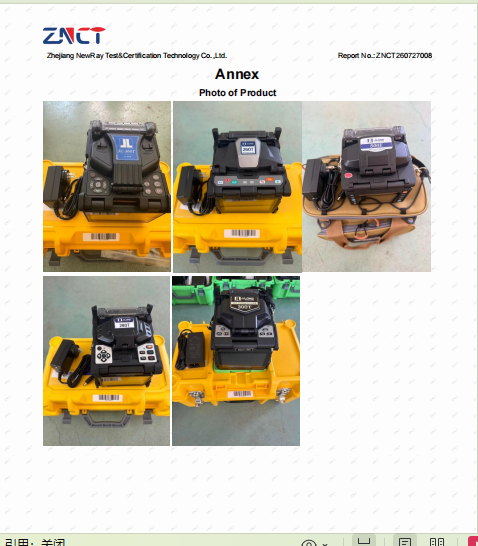
Engineered for FTTx drop‑cable deployment, field installation and maintenance, the JILONG 260T is a commemorative‑edition fusion splicer built on more than 33 years of optical‑fiber R&D and manufacturing experience. Adopting 4‑motor active cladding‑alignment technology, this unit balances reliable splicing performance, rugged mechanical construction and practical field‑oriented functions, making it a solid all‑round choice for access‑network projects worldwide.

Key Features
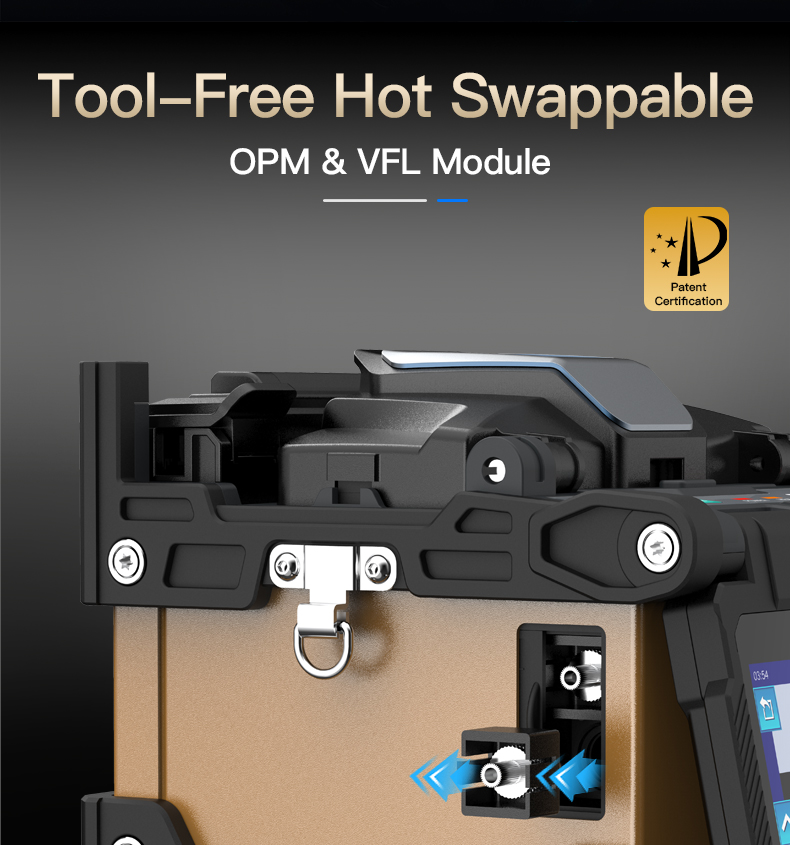
Tool‑free Hot‑swap OPM & VFL Integrated Module Built‑in tool‑free hot‑swap OPM and VFL module streamlines FTTx on‑site troubleshooting. Field technicians can replace the module directly without factory‑assisted disassembly, cutting the number of separate test tools carried during outdoor jobs.
High‑speed Splicing and Heating for Large‑scale FTTH Projects Delivers 8‑second fast splicing under quick mode for standard SM G.652 fiber, paired with 10‑second rapid heating for 40 mm protection sleeves. Reduced cycle time lowers overall labour costs for high‑volume fiber‑installation tasks. Heating duration is fully adjustable to match different protection sleeve specifications.
Tool‑free Detachable Integrated SOC Fixture The patented tool‑free SOC fixture enables fast switching between SOC splices, bare fiber, 0.25–3.0 mm patch cords and indoor drop cables. No screwdriver is required for fixture removal or replacement, improving workflow efficiency in field environments. A 3‑in‑1 universal fixture is equipped as standard.
Heavy‑duty Field‑proven Mechanical Design Internal structural components adopt a metal‑reinforced design; metal parts account for over 60 % of total weight excluding the battery. The unit passes a 2.5 m drop resistance test to withstand bumps and drops during outdoor transport and construction.
Wide Environmental Adaptability with Automatic Arc Calibration Automatic arc calibration compensates for changes in ambient temperature and atmospheric pressure. The unit supports operation at altitudes from 0 m up to 5 000 m. The working temperature range is −20 °C to +50 °C, adapting to desert, alpine, tropical‑humid and other harsh working conditions. Maximum tolerable wind speed reaches 15 m/s for outdoor field splicing.
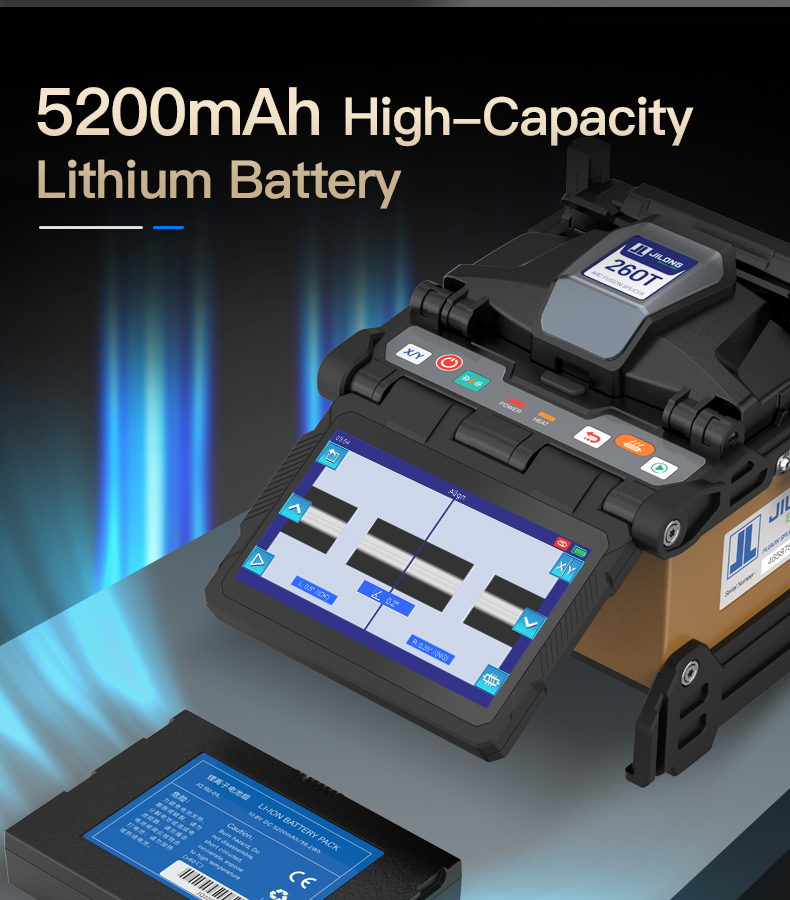
Long‑lasting Battery and Low‑cost Operation Equipped with a 5200 mAh lithium‑ion battery, the unit completes up to 350 full splice‑and‑heat cycles per single full charge under laboratory room‑temperature conditions. Electrodes provide approximately 5 000 arc discharges and are user‑replaceable.
Rich Data Storage & PC Remote Firmware Upgrade The unit stores up to 10 000 groups of splice records and 2 000 splice‑result images. Raw records and images can be exported via the USB 2.0 port for local archiving. Firmware can be updated through dedicated PC‑based remote upgrade tools to add new functions or optimise performance.
Multi‑language User Interface & Global Power Compatibility The touch‑screen system supports up to 17 UI languages to serve technicians across different regions. The power supply accepts a universal AC input of 100–240 V, compatible with mains‑grid standards in most countries.
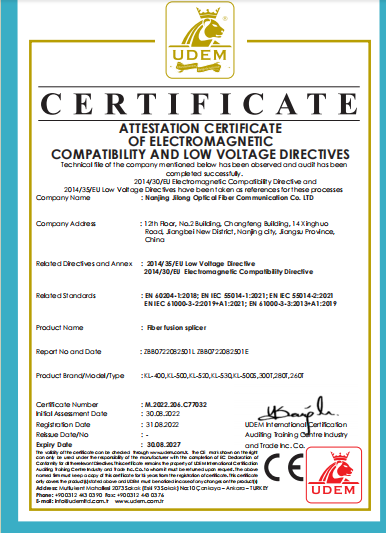
CE Compliance & Extended Warranty Compliant with EU 2014/30/EU EMC directive and 2014/35/EU LVD directive for European market access. Backed by a 3‑year full‑unit warranty to reduce total cost of ownership for operators and system integrators.
Technical Specifications
| Item | Parameter |
|---|---|
| Splice Method | 4‑motor Active Clad‑Alignment |
| Supported Fibers | SM (G.652 / G.657), MM (G.651), DS (G.653), NZDS (G.655) |
| Typical Splice Loss | SM: 0.02 dB / MM: 0.01 dB / G.657: 0.02 dB / DS: 0.04 dB / NZDS: 0.04 dB Measured in lab following ITU‑T & IEC cut‑back test method |
| Return Loss | ≥ 60 dB |
| Splicing Time | 8 s (Quick mode for SM G.652) |
| Heating Time | 10 s (Quick mode for 40 mm sleeve, adjustable) |
| Preset Modes | Max. 128 splice modes; Max. 32 heating modes |
| Estimated Splice Loss | Supported |
| Fiber Dimension | Cladding: 80–150 μm; Coating: 100–1000 μm Cleave length: 8–16 mm Compatible fiber: 0.25–3.0 mm fiber & indoor drop cable |
| Fixture | Tool‑free detachable integrated SOC fixture + 3‑in‑1 universal fixture |
| Integrated Module | Tool‑free hot‑swap OPM & VFL for on‑site FTTx troubleshooting |
| Data Storage | 10 000 splice records, 2 000 splice images USB 2.0 export of raw data & images; PDF acceptance report output: not available |
| Firmware Update | PC‑based remote tool upgrade |
| Display | 4.3‑inch capacitive touch screen, 320× magnification (X / Y / XY view) |
| Tensile‑test Strength | 1.96–2.25 N |
| Electrode Service Life | Approx. 5 000 arcs (replaceable) |
| Battery | 5200 mAh Li‑ion battery; typical 350 complete splice‑and‑heat cycles (lab room‑temperature test, actual performance varies with operating environment) |
| Operating Condition | Operating: −20 °C ~ +50 °C, altitude 0–5 000 m, humidity 0–95 %RH, max wind speed 15 m/s Storage: −20 °C ~ +60 °C, humidity 0–95 %RH |
| Mechanical Reliability | 2.5 m drop resistance; internal metal components ≥ 60 % excluding battery IP rating: not available |
| Power Input | AC 100–240 V universal input; DC 9–14 V |
| Weight & Dimension | 1.92 kg (with battery); 136.8 × 137 × 136.5 mm (with rubber bumper) |
| Localization | Multi‑language UI, supports up to 17 languages |
| Certification | CE (2014/30/EU EMC, 2014/35/EU LVD) |
| Warranty | 3‑year full‑unit warranty |
Application Scenarios
- FTTx fiber‑to‑the‑home network installation
- Indoor drop‑cable splicing and SOC‑type connector assembly
- Telecom operator field‑maintenance tasks
- Security‑monitoring optical‑cable construction
- Access‑network project deployment for system integrators
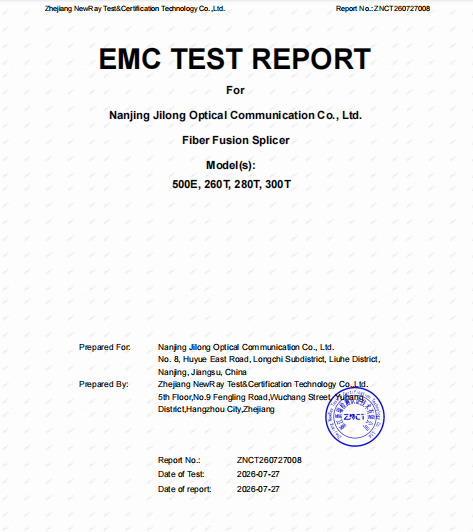
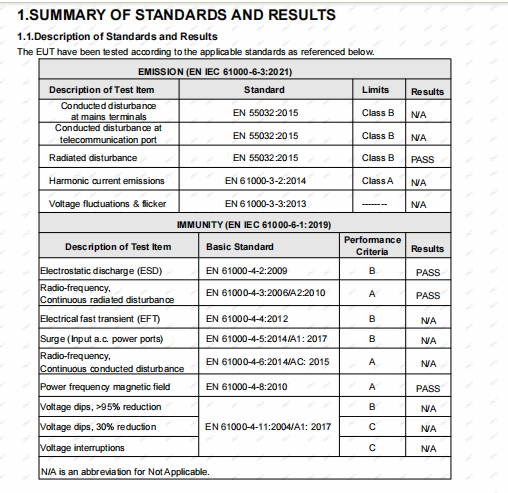
Engineered for worldwide FTTx field deployment, JILONG 260T 33rd‑anniversary fusion splicer features 4‑motor active cladding‑alignment, high‑speed 8 s splicing and 10 s heating. It is supported by official EMC test report No.ZNCT260727008 to meet EN IEC 61000‑6‑1 / 6‑3 standards. Verified lab‑test results prove reliable performance in complex electromagnetic environments, reflecting professional‑level quality assurance for telecom field‑working hardware.
Field Splicing Test Data — 100 Consecutive Splices
Test Conditions
| Item | Detail |
|---|---|
| Machine under test | JILONG 260T (unit No. 2) |
| Test date | 29 January 2026 |
| Measuring equipment | Insertion‑loss meter |
| Ambient temperature | Room temperature |
| Arc calibration values | Discharge 1: 47 bit / Discharge 2: 110.2 bit |
| Sample size | 100 consecutive splices (SM fiber) |
| Data recorded per splice | Cleave angle L, cleave angle R, splice loss |
Summary of Results
| Metric | Value |
|---|---|
| Sample size | 100 splices |
| Average splice loss | 0.01 dB |
| Median (P50) | 0.01 dB |
| 90th percentile (P90) | 0.02 dB |
| 95th percentile (P95) | 0.03 dB |
| 99th percentile (P99) | 0.05 dB |
| Minimum | 0.00 dB |
| Maximum | 0.05 dB |
| Splices at ≤ 0.01 dB | 75 % |
| Splices at ≤ 0.02 dB | 92 % |
| Average cleave angle (L / R) | 0.85° / 0.89° |
| Largest cleave angle recorded | 2.18° |
Splice Loss Distribution
| Splice loss (dB) | 0.00 | 0.01 | 0.02 | 0.03 | 0.05 |
|---|---|---|---|---|---|
| Number of splices | 37 | 38 | 17 | 6 | 2 |
| Share of sample | 37 % | 38 % | 17 % | 6 % | 2 % |
Full Measurement Records
| No. | Cleave L (°) | Cleave R (°) | Loss (dB) | No. | Cleave L (°) | Cleave R (°) | Loss (dB) |
|---|---|---|---|---|---|---|---|
| 1 | 0.20 | 1.23 | 0.01 | 51 | 0.92 | 0.25 | 0.00 |
| 2 | 0.99 | 0.52 | 0.01 | 52 | 1.15 | 0.70 | 0.00 |
| 3 | 1.90 | 1.58 | 0.03 | 53 | 1.29 | 0.07 | 0.00 |
| 4 | 1.14 | 1.29 | 0.01 | 54 | 1.42 | 1.12 | 0.00 |
| 5 | 1.43 | 0.76 | 0.00 | 55 | 1.17 | 0.82 | 0.01 |
| 6 | 1.46 | 1.31 | 0.00 | 56 | 0.98 | 1.74 | 0.01 |
| 7 | 0.76 | 0.72 | 0.00 | 57 | 0.72 | 0.67 | 0.01 |
| 8 | 1.43 | 1.04 | 0.00 | 58 | 0.80 | 0.66 | 0.01 |
| 9 | 0.40 | 0.35 | 0.01 | 59 | 0.41 | 1.95 | 0.00 |
| 10 | 0.50 | 0.71 | 0.01 | 60 | 0.49 | 1.52 | 0.00 |
| 11 | 0.57 | 0.57 | 0.00 | 61 | 0.17 | 0.61 | 0.01 |
| 12 | 1.94 | 1.42 | 0.02 | 62 | 0.21 | 0.59 | 0.01 |
| 13 | 0.87 | 0.97 | 0.01 | 63 | 0.26 | 0.88 | 0.01 |
| 14 | 0.61 | 0.10 | 0.00 | 64 | 0.35 | 0.83 | 0.01 |
| 15 | 0.67 | 0.60 | 0.00 | 65 | 0.63 | 0.12 | 0.02 |
| 16 | 0.38 | 1.66 | 0.00 | 66 | 0.25 | 0.59 | 0.01 |
| 17 | 0.49 | 1.71 | 0.01 | 67 | 0.52 | 0.59 | 0.01 |
| 18 | 0.54 | 0.83 | 0.02 | 68 | 0.98 | 0.41 | 0.00 |
| 19 | 0.73 | 0.78 | 0.01 | 69 | 1.61 | 0.40 | 0.00 |
| 20 | 0.54 | 0.55 | 0.01 | 70 | 0.35 | 1.06 | 0.01 |
| 21 | 1.25 | 1.20 | 0.01 | 71 | 0.80 | 1.27 | 0.01 |
| 22 | 0.88 | 0.25 | 0.01 | 72 | 0.27 | 0.93 | 0.02 |
| 23 | 0.29 | 0.68 | 0.01 | 73 | 0.70 | 1.07 | 0.01 |
| 24 | 0.93 | 1.43 | 0.00 | 74 | 0.51 | 0.79 | 0.00 |
| 25 | 1.26 | 0.80 | 0.01 | 75 | 0.76 | 0.76 | 0.02 |
| 26 | 1.44 | 1.16 | 0.00 | 76 | 0.80 | 0.19 | 0.02 |
| 27 | 0.37 | 1.53 | 0.00 | 77 | 0.81 | 0.44 | 0.00 |
| 28 | 0.53 | 1.93 | 0.01 | 78 | 1.47 | 0.56 | 0.01 |
| 29 | 0.61 | 1.67 | 0.01 | 79 | 0.52 | 1.67 | 0.02 |
| 30 | 0.83 | 0.82 | 0.01 | 80 | 0.74 | 0.91 | 0.00 |
| 31 | 1.13 | 1.42 | 0.01 | 81 | 0.52 | 0.47 | 0.02 |
| 32 | 2.00 | 1.88 | 0.02 | 82 | 0.54 | 0.19 | 0.02 |
| 33 | 0.43 | 0.58 | 0.00 | 83 | 0.69 | 0.66 | 0.00 |
| 34 | 0.22 | 1.68 | 0.00 | 84 | 0.55 | 0.40 | 0.00 |
| 35 | 2.18 | 0.95 | 0.01 | 85 | 1.01 | 0.69 | 0.00 |
| 36 | 1.04 | 0.22 | 0.02 | 86 | 0.60 | 0.79 | 0.00 |
| 37 | 0.54 | 0.77 | 0.02 | 87 | 0.22 | 1.02 | 0.00 |
| 38 | 1.44 | 0.99 | 0.00 | 88 | 0.38 | 0.33 | 0.02 |
| 39 | 1.02 | 0.74 | 0.00 | 89 | 0.91 | 1.37 | 0.01 |
| 40 | 0.73 | 0.28 | 0.02 | 90 | 1.06 | 1.01 | 0.02 |
| 41 | 0.64 | 0.82 | 0.02 | 91 | 1.12 | 0.53 | 0.01 |
| 42 | 0.56 | 0.10 | 0.00 | 92 | 0.61 | 0.74 | 0.00 |
| 43 | 1.52 | 0.28 | 0.00 | 93 | 1.96 | 0.80 | 0.05 |
| 44 | 0.54 | 1.10 | 0.05 | 94 | 0.18 | 1.00 | 0.01 |
| 45 | 0.82 | 1.60 | 0.02 | 95 | 1.35 | 1.61 | 0.00 |
| 46 | 0.92 | 0.53 | 0.01 | 96 | 1.37 | 0.40 | 0.00 |
| 47 | 2.13 | 1.86 | 0.03 | 97 | 0.74 | 0.39 | 0.03 |
| 48 | 1.02 | 1.88 | 0.00 | 98 | 0.83 | 1.05 | 0.03 |
| 49 | 1.30 | 1.19 | 0.03 | 99 | 0.67 | 0.63 | 0.01 |
| 50 | 1.09 | 0.88 | 0.01 | 100 | 0.73 | 0.59 | 0.03 |
Reading the Data
The 100 splices show a mean splice loss of 0.01 dB, with 75 % of all splices at or below 0.01 dB and 92 % at or below 0.02 dB. Only two splices in the entire sample reached 0.05 dB. Even the worst splice in the sample stays within the 0.05 dB range, while cleave angles as high as 2.18° are still accepted by the automatic arc‑calibration routine — a direct demonstration of how the estimated‑loss feedback and adaptive discharge control reduce dependence on operator cleaving skill in high‑volume FTTH field work.
Notes: all test‑based figures are obtained under standard laboratory conditions. Real‑world performance may be influenced by fiber quality, cleaving quality, temperature, humidity and field operation habits.
https://www.jilongot.com/
南京吉隆光纤通信股份有限公司