
Replacing an industrial IoT communication device in an automation project is rarely a simple hardware swap.
A router, modem, or serial communication gateway may appear to be a small component of an automation system, but it often sits directly between PLCs, meters, sensors, remote I/O, industrial computers, and the central monitoring platform. When that communication device is replaced, engineers need to make sure the new hardware fits the existing interfaces, protocols, network structure, security policy, and physical installation.
That is why companies searching for an industrial IoT replacement for automation projects should not focus only on cellular speed or the number of Ethernet ports.
The more practical question is whether the replacement equipment can perform the same communication functions while making the migration controlled and predictable.
For system integrators, automation engineers, and industrial equipment manufacturers, a successful replacement should ideally minimise changes to the field equipment and application layer. It should also provide a clear path for future upgrades, remote maintenance, and larger deployments.
E-Lins Technology specialises in industrial M2M and IoT wireless communication equipment and has developed solutions for distributed industrial environments where reliability and long-term connectivity are important.
Why Industrial Communication Replacement Projects Are Different
Industrial automation networks are usually not designed from scratch every few years.
A production line or remote monitoring system may combine equipment installed at different times. A PLC may be relatively modern, while a meter, controller, or sensor interface has been operating for much longer.
The communication layer therefore needs to accommodate technology generations that were never necessarily designed to work together.
The router is part of the automation architecture
In a typical remote automation installation, the communication path could include a PLC or RTU, an industrial router or modem, a cellular or wired network, a VPN connection, and a SCADA or cloud platform.
Changing the router can affect several parts of that chain.
For example, the replacement device may use a different serial interface, require different IP settings, handle VPN configuration differently, or change how remote access is established.
A good migration therefore begins by documenting the current architecture before choosing the replacement device.
The easiest replacement usually preserves working elements
A common objective in industrial retrofit work is to modernise connectivity without replacing equipment that is still performing its original function.
If the existing PLC communicates through RS485 and Modbus, there may be little benefit in replacing it merely because the old cellular modem has reached the end of its lifecycle.
A communication device that can preserve the existing interface and data path can reduce migration complexity.
Start With Interfaces, Not Product Names
The first technical step in an industrial IoT replacement project is to identify exactly what the existing device is connected to.
RS232 and RS485 remain important
Many industrial applications still use serial communication.
RS232 can be found in certain controllers, meters, and specialised industrial equipment, while RS485 is widely used where multiple devices need to communicate over a shared serial bus.
A replacement device therefore needs to support the interfaces actually present in the installation.
E-Lins Technology provides industrial communication products supporting RS232 and RS485, including the M300/M400 Industrial 4G Modems. These products support serial transparent transmission, allowing existing serial equipment to communicate through a cellular network.
This approach can be particularly useful in retrofit projects because the communication method used by the legacy equipment does not necessarily need to be redesigned.
Ethernet requirements can be more complex than expected
Modern automation systems increasingly rely on Ethernet-connected PLCs, industrial computers, cameras, gateways, and sensors.
It is important to determine how many Ethernet devices need to be connected and whether they require Gigabit networking.
The H900 Gigabit Industrial 4G Router from E-Lins provides five Gigabit Ethernet ports, offering local connectivity for multiple devices.
For projects with greater wireless bandwidth requirements, the H900f Gigabit 5G Industrial Router provides 5G SA/NSA connectivity together with Gigabit-class networking.
The important point during replacement planning is that Ethernet capacity should reflect the actual local architecture instead of being selected purely from a product specification sheet.
Protocol Compatibility Can Determine Whether a Replacement Works
Interfaces define how equipment connects physically. Protocols define how data is exchanged.
In automation projects, a communication device may need to transport data generated through industrial protocols while also supporting IP networking on the backhaul side.
Modbus is common in legacy systems
Modbus remains widely used for industrial communication, particularly with meters, PLCs, controllers, and instrumentation.
A replacement communication device should be tested against the actual Modbus configuration used by the project.
Factors such as serial parameters, addressing, data polling, TCP routing, and transparent transmission behaviour may all affect the migration.
E-Lins supports Modbus and TCP/IP within its industrial communication portfolio, alongside RS232 and RS485 interfaces.
This provides system integrators with a way to connect existing industrial devices to cellular networks without necessarily introducing an entirely new protocol layer.
Transparent transmission can reduce application changes
In a transparent-transmission architecture, the communication device focuses on moving the existing data between the field equipment and the remote system.
This can be valuable when the automation software is already stable.
Rather than rewriting the SCADA logic or changing PLC communication behaviour, the project can focus the replacement work on the communication layer.
This does not mean every automation project should use transparent transmission. The correct approach depends on the existing architecture. However, it is an important feature to consider when replacing legacy industrial communication equipment.
Cellular Migration Does Not Have to Mean a Complete Network Redesign
A replacement project may be driven by several factors: hardware lifecycle, changing network requirements, maintenance problems, new deployment regions, or the need to introduce 5G.
The cellular technology can change while the industrial application remains largely the same.
Moving from 4G to 5G
Not every industrial application needs 5G immediately.
Many PLC monitoring systems, meters, environmental sensors, and distributed controllers can continue operating effectively with 4G connectivity.
However, applications involving high-definition video, larger data volumes, lower latency requirements, or edge-related workloads may justify a move to 5G.
E-Lins supports both 4G and 5G industrial communication products, which allows customers to plan technology migration according to application requirements rather than replacing every installed device at the same time.
The company's development history began with 2G/3G industrial modems and expanded into 3G routers and DTUs, full 4G LTE product lines, and later 5G NR industrial routers and edge computing gateways.
For long-term automation projects, this multi-generation experience can be useful because industrial networks often evolve gradually.
Consider the Physical Installation During Replacement
A communication device may be technically compatible but physically unsuitable.
Industrial cabinets can have very limited free space. Field equipment may require DIN-rail mounting, wall mounting, embedded installation, or outdoor deployment.
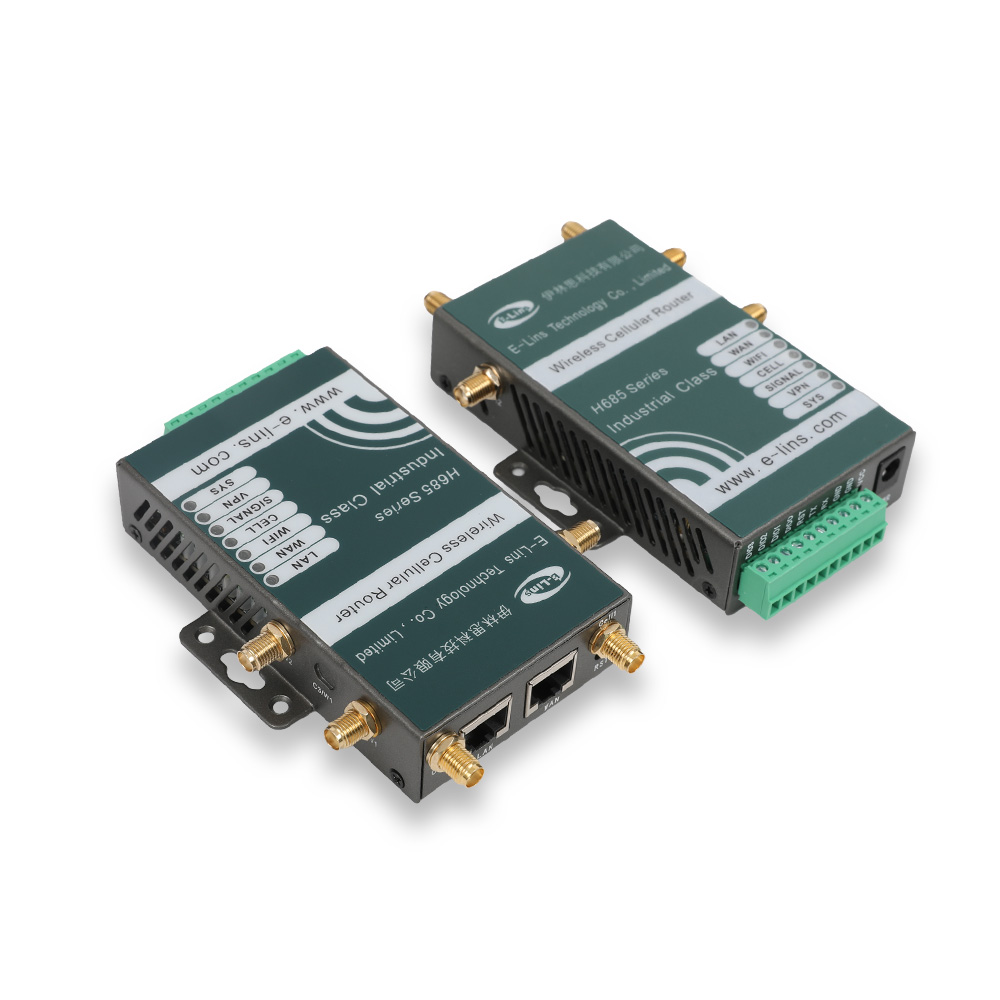
Compact equipment for embedded systems
The H685f/H685 Mini Embedded Series is designed for space-constrained integration projects and measures 100 × 60 × 21 mm.
It combines Ethernet, serial, and DI/DO interfaces, making it suitable for applications where the communication device needs to be integrated into a machine, kiosk, robot, or other compact industrial system.
For replacement projects, a smaller footprint can be important because the existing enclosure may have been designed around the original equipment.
Outdoor replacement needs environmental protection
When the existing communication device is installed outside, the replacement needs to be evaluated against the actual weather conditions.
The E-Lins H820QO Outdoor IP68 Waterproof Router is designed for outdoor 4G applications and has an IP68-rated enclosure. It also incorporates built-in 14dBi high-gain antennas for field environments where signal reception can be challenging.
This type of hardware can be relevant to remote automation systems, energy installations, monitoring stations, and other applications where a conventional indoor networking device would require additional protection.
Reliability Should Be Part of the Replacement Decision
One reason companies replace industrial networking equipment is not simply technological obsolescence. The original hardware may also have become difficult to maintain.
Frequent disconnections, unexpected freezing, or manual restart requirements can create recurring operational work.
Hardware recovery functions matter
E-Lins industrial communication equipment supports hardware watchdog timers and link self-healing mechanisms.
These functions are intended to help the equipment recover from certain abnormal conditions automatically.
For an unattended automation site, this can be more useful than a small improvement in peak network performance.
An industrial router that can recover from a communication abnormality without requiring someone to travel to the site can reduce the operational impact of connectivity faults.
Industrial components should match the field environment
E-Lins specifies industrial-grade components with a working temperature range of -35°C to +75°C, as well as 15KV ESD protection and 1.5KV electromagnetic isolation.
These specifications are relevant when replacement equipment is deployed in industrial cabinets, transportation equipment, energy installations, or other environments where temperature and electrical conditions may be more demanding than in conventional office networking.
Security Is Often Overlooked During Equipment Replacement
When an industrial communication device is replaced, security settings must move with the architecture.
The new equipment may need to connect to an existing VPN, enterprise network, SCADA platform, or remote engineering environment.
VPN compatibility should be verified early
E-Lins supports WireGuard, IPsec, and OpenVPN.
This provides several options for encrypted communications between remote industrial sites and central networks.
During a replacement project, engineers should confirm the required VPN topology, authentication method, routing rules, addressing scheme, and remote-access permissions before installation.
Otherwise, the hardware may be operational while the site remains unable to communicate securely with the central platform.
Remote access should be controlled
Remote maintenance is valuable for industrial equipment, but it should not mean unrestricted exposure to the public Internet.
A well-designed replacement architecture should define which users and systems can access field equipment, how those sessions are authenticated, and which network services are permitted.
This is particularly important when a single router provides the communication path for multiple PLCs or industrial devices.
Centralized Management Makes Large Replacements Easier
Replacing one industrial router is relatively straightforward.
Replacing hundreds of devices across distributed sites is a completely different project.
Standardized configuration reduces deployment effort
E-Lins supports centralized management and network integration through TR-069, SNMP, SSH, and NMS cloud platforms.
These capabilities can help system integrators manage device configuration and monitoring at a larger scale.
A standardized configuration model can also reduce differences between sites. This becomes important when the project team needs to deploy the same communication architecture repeatedly across factories, infrastructure installations, transport equipment, or energy sites.
Remote diagnostics can simplify support
A communications fault should ideally be diagnosed before a technician is dispatched.
E-Lins provides 7x24-hour remote technical support, including packet capture analysis and remote debugging. The company reports a 90% remote issue-resolution rate.
For replacement programmes, this can be useful during both commissioning and the later operational phase. When a newly installed device does not communicate as expected, engineers can investigate the network path remotely instead of treating every problem as a field-service issue.
Planning a Replacement Without Interrupting Automation
The most practical replacement programmes usually treat the migration as a controlled engineering process.
Document the existing device
Before removing the old equipment, record:
The current interface type.
Serial communication parameters.
IP addressing.
Routing rules.
VPN configuration.
Connected equipment.
SIM and cellular requirements.
Remote-management method.
Physical mounting and power connections.
This baseline provides the reference for configuring the replacement device.
Test with representative equipment
A laboratory test using the same or equivalent PLC, controller, meter, or gateway can identify compatibility issues before the field installation.
Testing should include data transmission, reconnect behaviour, VPN connectivity, remote access, protocol performance, and power-cycle recovery.
For larger projects, testing one representative site before rolling out the replacement architecture across the entire fleet is a practical way to identify configuration problems early.
Maintain a rollback path
Industrial systems should not be treated like ordinary office networks.
During a replacement, the project team should have a clear rollback method in case the new communication device cannot meet the application's requirements.
This may involve keeping the original device available until the new configuration has passed acceptance testing and confirming that all critical configuration information has been documented.
Why E-Lins Technology Can Be Considered for Industrial IoT Replacement Projects
Shenzhen E-Lins Technology Co., Ltd. is a technology-driven manufacturer focused on industrial M2M and IoT wireless communication equipment. The Shenzhen entity was founded in 2012, while the company's industrial roots date back to 1999.
E-Lins Technology has developed communication products across multiple cellular generations and now serves customers and system integrators in more than 150 countries and regions.
Its product range covers industrial 4G routers, 5G industrial routers, embedded communication products, and industrial modems and DTUs.
For automation replacement projects, several parts of its portfolio are directly relevant.
The M300/M400 Industrial 4G Modems support RS232/RS485 serial transparent transmission for legacy equipment.
The H900 Gigabit Industrial 4G Router provides five Gigabit Ethernet ports and is designed for M2M, vehicle, and security applications.
The H900f Gigabit 5G Industrial Router supports 5G SA/NSA, dual-SIM hot backup, PoE++, and high-bandwidth industrial networking.
The H685f/H685 Mini Embedded Series addresses space-constrained installations, while the H820QO provides an IP68-rated outdoor 4G form factor.
This range allows replacement projects to select different communication architectures without forcing every automation application into the same hardware format.
Software and Manufacturing Experience Also Matter
Replacing industrial communication hardware is not only a product-selection exercise.
Long-term support, firmware control, customization capability, and manufacturing consistency can affect whether a replacement remains practical after the initial installation.
E-Lins states that its industrial communication firmware is 100% self-developed and that it has approximately 20 years of independent R&D experience in wireless data communication.
The company provides OEM/ODM customization in addition to standardized delivery and maintains an in-house SMT factory and assembly lines in Shenzhen, with monthly production capacity reaching tens of thousands of units.
E-Lins also provides lifetime free firmware upgrades and 7x24 technical support.
For a system integrator replacing an established communication platform, these capabilities can be relevant because the project may continue for years after the initial hardware migration.
Choosing an Industrial IoT Replacement Is Really About Compatibility
An automation project does not need to replace a working control architecture simply because its existing communications equipment needs to be upgraded.
A more controlled approach is to identify what already works and replace the part of the network that requires improvement.
That means looking at interfaces first, then protocols, VPN architecture, network topology, physical installation, environmental conditions, remote management, and future technology requirements.
For legacy automation equipment using RS232 or RS485, serial transparent transmission can provide a practical migration path.
For Ethernet-based systems, sufficient local ports and network capacity become more important.
For newer high-bandwidth applications, 5G may provide a useful upgrade path while existing 4G systems remain in service elsewhere.
For geographically distributed projects, centralized management and remote diagnostics can significantly influence the total operational workload.
E-Lins Technology approaches industrial connectivity from this broader perspective, combining cellular routers, embedded communication products, industrial modems, independently developed firmware, industrial interfaces, VPN support, and management technologies.
For companies evaluating an industrial IoT replacement for automation projects, the strongest replacement is not necessarily the device with the longest specification list. It is the one that fits the existing automation environment, reduces unnecessary redesign, supports the required communication path, and provides a practical foundation for the next stage of the project's lifecycle.
https://e-lins.com/
Shenzhen E-Lins Technology Co., Ltd.