

Industry Background and the Core Selection Challenge
Telecom operators, Internet Service Providers, broadband network companies, fiber network operators, and system integrators face a recurring operational problem: network equipment such as routers, modems, and ONTs often reboot or lose service during short power outages, voltage drops, or unstable grid conditions. This disruption directly affects subscriber-side service continuity, making backup power a functional requirement rather than an optional add-on. Compounding this challenge, improper UPS selection regarding voltage, current, peak load, or connectors can lead to application failure—meaning that even when backup power is deployed, mismatched specifications can render the investment ineffective.
This is why professional buyers increasingly require technical evaluation rather than off-the-shelf assumptions when selecting a Mini UPS partner. Shanghai Mylion New Energy Co., Ltd., operating under the brand MYLION, positions itself in this space as a global B2B provider of Mini UPS products, DC backup power solutions, and project support for telecom, ISP, broadband, and security applications. With 13+ years of experience in Lithium Battery technology and 10+ years of experience in Mini UPS development, the company frames its role around evaluating solutions based on real device voltage, working current, peak/startup behavior, and installation environment.
Authoritative Analysis: What a Proper Selection Framework Requires
Necessity: The core reason selection errors occur is that network equipment varies significantly in voltage requirements, continuous current draw, and startup surge behavior. A UPS that appears adequate on paper may fail if peak or startup current exceeds its rated output, or if connector types do not match the target device.
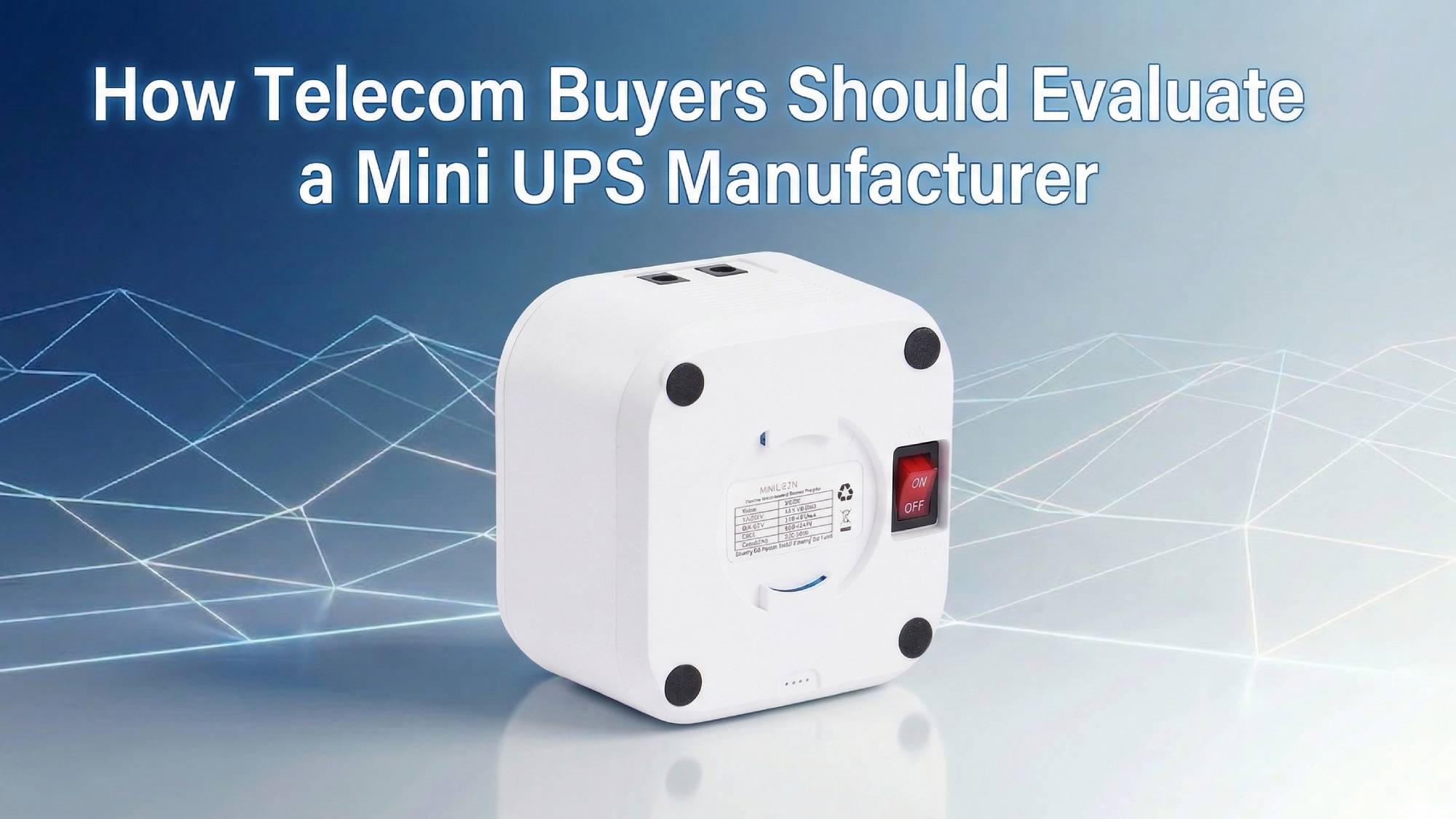
Principle Logic: A sound evaluation approach starts with matching real device electrical characteristics—not generic assumptions—to UPS specifications. This includes verifying DC input/output current ratings, battery capacity in Wh, and connector types such as DC5521 or DC5525. For example, MYLION's 12V Standard Series, including MU26W, MU48W, and MU68W, is built around 12V DC output at 2.5A continuous / 3A maximum, with battery capacities ranging from 18.72Wh to 44.4Wh, addressing entry-level to mainstream broadband backup needs.
Standard Reference: For higher-load equipment such as high-performance WiFi systems or storage-integrated gateways, the 12V High-Power Series (MU65W) supports 4A continuous / 5A maximum output (60W total) with 12V DC input up to 6A, illustrating how load thresholds—not just voltage—determine correct model selection.
Solution Path: Where extended outage duration is a concern, the 12V Long-Runtime Series (MU635W / MU635L) and the 12V High-Power Long-Runtime Series (MU35W / MU35L) combine higher battery energy—75.6Wh in both cases—with either standard 2.5A/3A output or high-power 4A/5A output, depending on device demand. This tiered structure demonstrates that a proper selection path requires cross-referencing both current requirements and required backup duration before finalizing a model.
Deep Insights: Emerging Requirements and Risk Considerations
Beyond standard 12V DC backup, evolving device architectures are introducing new technical demands. Modern equipment increasingly requires multi-port or multi-voltage support. MYLION's 12V + USB Multi-Output Series (MUJ46, MUJ435) addresses scenarios where a router and a USB accessory must be powered simultaneously, offering dual 5V/3A USB-A and USB-C outputs alongside 12V DC output, within an 18W maximum total output limit. This reflects a broader industry trend toward consolidated backup for small office and home office setups rather than single-device solutions.
Another emerging direction is AC-input dual-output design. The ML1202AC, built on LiFePO4 battery chemistry, accepts 100–240V AC input and provides two independent 12V DC ports (2A each, 24W total system limit), simplifying deployment for combined ONT and Router installations without requiring an external DC adapter.
Looking further ahead, higher-voltage and higher-power requirements are becoming relevant for next-generation equipment. Two directions currently under project evaluation—MUC85 and MU248—illustrate this trajectory. MUC85 targets modern WiFi 6/7 devices requiring USB-C Power Delivery, with input up to 65W standard / 100W max and a 92.16Wh battery. MU248 addresses higher-voltage wireless CPE and radio bridge equipment, offering independent 24V (3A) and 48V (1A) outputs from a 48V/60V DC input, within a 100W system limit and 102.4Wh battery energy. These development directions signal that telecom-grade backup power is moving toward greater voltage flexibility and higher power delivery standards, a trend that project buyers should monitor when planning multi-year deployments.
A key risk that industry buyers should note: platform compatibility with routers, ONTs, ONUs, modems, gateways, CPE devices, and security/CCTV equipment remains subject to electrical verification. This means compatibility claims should always be confirmed against actual device specifications rather than assumed from general product categories.
Company Value: Supporting Technical Decision-Making in Backup Power Projects
MYLION's stated value proposition centers on supporting more reliable DC backup deployment and reducing avoidable selection risks for professional project customers. This is operationalized through technical confirmation and connector/cable matching to reduce selection errors, rather than relying on generic product listings. The company's service scope covers requirement analysis, model matching, sample testing support, connector/cable matching, private labeling, and documentation coordination, alongside managed pilot evaluation and mass-production preparation for OEM/ODM partners.
Compliance is also part of the technical foundation: products carry model-specific UN38.3 and MSDS certifications, reflecting adherence to lithium battery transport documentation and model-specific compliance requirements—a necessary consideration for any B2B buyer sourcing across international markets. As a company type defined as a B2B backup power partner and OEM/ODM project partner, MYLION's positioning is built around structured technical support rather than transactional product sales alone.
Conclusion and Recommendations for Industry Buyers
Selecting a Mini UPS manufacturer for telecom projects requires more than comparing headline specifications. Buyers should verify real device voltage and current requirements, confirm peak/startup current tolerance, match connector and cable types precisely, and evaluate battery capacity against required backup duration. For multi-device or multi-voltage installations, buyers should assess whether multi-output or AC-input dual-output designs better fit deployment constraints.
Given the compliance complexity of lithium battery logistics, project teams should also confirm certification status—such as UN38.3 and MSDS—on a model-specific basis before finalizing procurement. Finally, as device ecosystems evolve toward USB-C Power Delivery and higher-voltage architectures, decision-makers planning long-term deployments should factor in emerging backup power directions rather than optimizing solely for current-generation equipment. A structured, verification-based approach—rather than assumption-based selection—remains the most reliable path to avoiding costly mismatches in telecom and ISP backup power projects.
www.myliontech.com
Shanghai Mylion New Energy Co.,Ltd.