
Published: November 2026 | By Fengzai Foodservice Team
In Jiaodong, on the eastern tip of Shandong province, families do not send greeting cards when something important happens. They send buns. "We don't send greeting cards for occasions," says Gai Yaping, a city-level inheritor of Jiaodong huabobo from Yantai. "We celebrate important occasions with buns." A tiger arrives for a baby's first month, a peach the size of a child's face for a grandparent's birthday, peonies and mandarin ducks for a wedding. That habit is three centuries old, and it is the most under-used sales asset in Chinese restaurants abroad — because it explains why a guest will happily pay for forty grams of dough. They are not buying bread. They are buying a blessing they can eat, and understanding huabobo flower steamed buns history and meaning is the difference between selling dumplings and selling a ritual.
1. Where Do Huabobo Come From, and What Do the Shapes Actually Say?
From the Jiaodong peninsula — Yantai, Weihai, Qingdao — and from a practical problem: how to say something out loud without a card. The form is at least 300 years old, and probably older than any record of it, since the earliest versions were made for offerings rather than for sale. They are wheat buns four to six times the size of an ordinary mantou, shaped by hand, decorated with red dates and coloured dough, and eaten as readily as they are displayed. The craft was added to Shandong's provincial intangible cultural heritage list in 2009, and it survives today mostly in rural households and in the hands of a few hundred recognised inheritors.
The vocabulary is precise, and this is where most English-language menus lose the plot. With traditional chinese festive steamed bun shapes explained properly, the pieces stop being decorations and start being sentences: a tiger for a one-month-old, so the child grows strong; a peach for longevity, given by grandchildren to grandparents; peonies, dragons, phoenixes and mandarin ducks for a wedding, each carrying a different promise about the marriage; pomegranates for many children; fish for surplus; lion for protection. The same repertoire covers a housewarming, a new shop opening and a funeral, which is why a Shandong family can hold an entire conversation with a steamer.
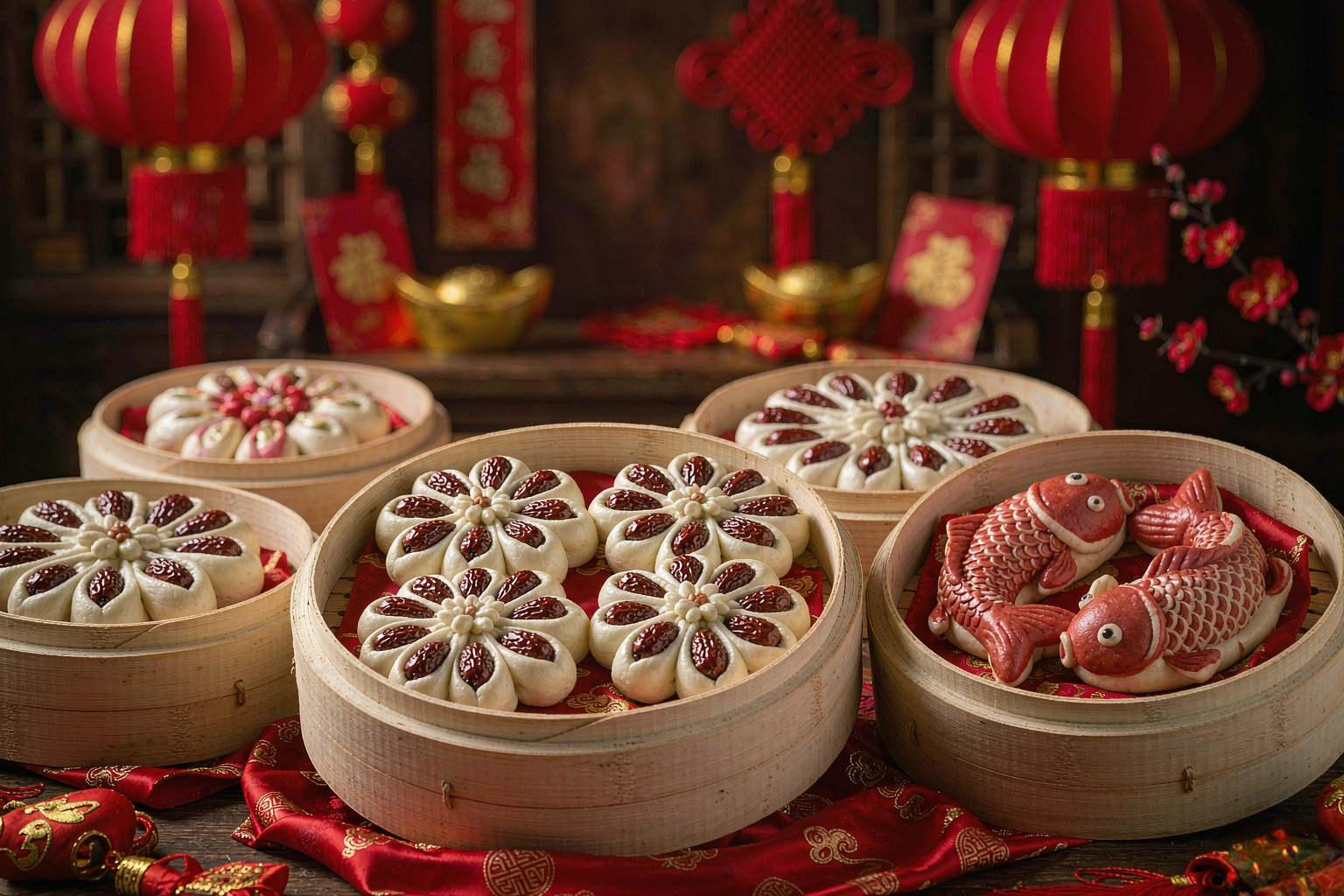
At New Year the language shifts to the year ahead, and flower shaped steamed buns for chinese new year are the most photographed form of it: blossom shapes with red dates pressed into the petals, fish for abundance, and one large showpiece for the table. There is even a pun built into the process — zheng, to steam, sounds like the word for rising, so steaming a bun is itself a wish that fortunes will rise. That is the kind of detail a menu can use; a photo of a bun cannot.
None of it is quick to learn. The tools are ordinary — scissors, chopsticks, a spoon, a comb — but Gai puts the apprenticeship at one to two years before a maker can work fluently, because the shaping is not standardised and never has been. Which raises the obvious commercial question: if the craft is handmade and unhurried, how does a restaurant chain serve it on a Tuesday night?
✅ Bottom line: each shape is a sentence, not a garnish. If the menu does not translate the sentence, the guest sees a cute bun and pays a cute-bun price.
2. How Do You Turn a Folk Story Into Menu Collateral?
With three pieces of paper, not a lecture. Restaurants that try to explain three centuries of folklore end up with a paragraph nobody reads. The version that sells is shorter and does one job per surface. A menu story card of 40-60 words sits under the dish name and answers a single question: what does this shape wish you? A table card shows the shape family — three silhouettes, one line each — so a table can decode the whole menu at a glance, which is traditional chinese festive steamed bun shapes explained at its most compressed. And a 30-second server script gives the floor team something repeatable to say at the plate drop, which is when guests actually ask.
The script matters more than the card. Something close to this works in any English-speaking market: "This is a peach, for long life — we give it at birthdays. The pink is red yeast rice, not colouring. The filling is salted egg custard." Three facts, twelve seconds, no folklore degree required. Multiply it across a table of ten and you have converted a side order into the reason the table photographs the meal, which is the same mechanism that makes a celebration cake worth its price.
That comparison is not rhetorical. On Chinese e-commerce platforms, buyers of huabobo leave reviews that place it directly against cake: "more practical and prettier than a cream cake," one wrote after buying for a father's birthday; another called it "a total hit at the birthday dinner … perfect for anyone who isn't into cake." Read commercially, that is a category claim. A shaped bun already competes for the celebration occasion — it simply has not been priced or positioned as if it does. The craft's own inheritors make the point bluntly: "If you take one home, please don't just leave it on a shelf. Eat it," Gai says. Beautiful to look at, better to taste.
✅ Bottom line: one story card, one table card, one twelve-second script. That is the whole content system, and it is worth more than a redesign of the menu.
3. Can a Factory Match a Handmade Standard?
On the step that decides quality, yes — and Gai explains why in one sentence. "The shaping itself isn't standardized. It's handcrafted, not machine-made. But the fermentation has a standard," she says. "No matter how beautiful the sculpting is, if the fermentation fails, everything is ruined." That is the whole argument for industrial production of a folk craft. The variable that ruins a batch is not artistry, it is fermentation — temperature, humidity and time — and fermentation is exactly what a factory controls to a curve rather than to a feeling. The shape can be tooled; the proof cannot be improvised.
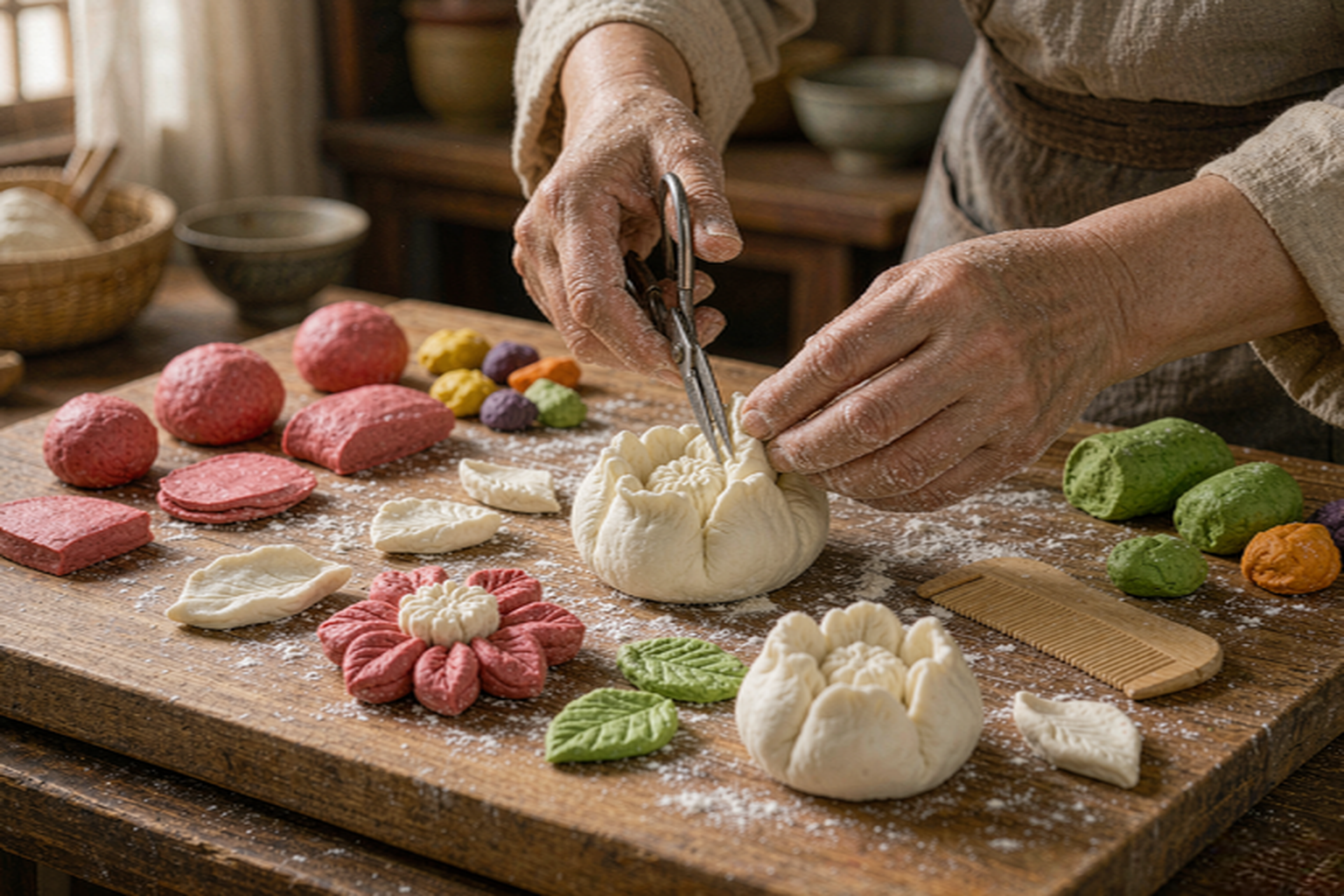
The rest of the craft translates the same way. Steam time is a function of size — a 50-gram bun needs about 10 minutes, a 500-gram showpiece more than an hour — so a production spec sheet replaces the cook's intuition with a table, and a restaurant gets the same result from a steamer it does not have to watch. Colour is the other place where handmade and industrial converge: spinach for green, pumpkin for yellow, purple sweet potato for purple, red yeast rice for the pinks and reds. No artificial dye, which matters the moment a guest asks what the pink ear is made of — and in a market where clean-label claims are checked, "vegetable powder" is a better answer than a number.
Freezing is what makes it operational. Blast-frozen at -18°C with a 12-month shelf life and steamed from frozen, the pieces skip the thawing step that cracks a shaped surface and skip the overnight proof that a restaurant kitchen has no room for. What the kitchen inherits is the shape and the story; what it does not inherit is the two-year apprenticeship.
✅ Bottom line: the artisan standard lives in fermentation, not in the wrist. Control the proof and the shape survives the journey from a Shandong kitchen to a hotel steamer.
4. Which Fengzai Lines Carry This Story?
Everything above is huabobo flower steamed buns history and meaning in theory; the commercial translation is a product range. Fengzai builds three lines that carry the shape language without pretending to be folk art: flower-shaped rice cakes in the Jiangnan idiom — cherry blossom, osmanthus, tricolour quinoa — where the flower is pressed rather than sculpted; the wormwood series, including the wormwood glutinous rice cake and QQ cakes, which carry the spring-and-green association that Chinese guests read instantly; and the figurative bun line — peach, apple, tangerine — which is the shape most restaurants actually put on a banquet menu.
The range is produced by Zhejiang Fengzi Food Co., Ltd., a frozen flour and rice products manufacturer in Quzhou, China, operating since 2004, with a modern production base since 2018 and a Hangzhou R&D center opened in 2025 for custom development. For a hotel or chain that wants its own silhouette — a house flower, a wedding pair, a zodiac piece — the R&D team develops the shape and produces samples for approval, typically within 30-60 days, with ISO 22000 and HACCP documentation behind it. The full range sits on the Fengzai products page, and the flower-shaped rice cakes referenced above are on the cherry blossom rice cake page.
✅ Bottom line: the story needs a product to land on. Pick the shapes your menu can explain in one line, and let the range do the rest.
Frequently Asked Questions
Q: Will guests outside China understand the symbolism?
A: One line is enough — a lecture is not. The mistake is explaining the history; the win is naming the wish. Guests do not need to know that the tradition is 300 years old, they need to know that the peach means long life and that the pink is a vegetable. Restaurants that get huabobo flower steamed buns history and meaning right usually do it in a single clause on the menu and a single sentence at the table.
Q: Do you provide English story material we can print?
A: Yes — a story-card template with the 40-60 word format, three table-card layouts and a translated server script, all written for restaurant use rather than for a museum. The rule we apply is that traditional chinese festive steamed bun shapes explained in a restaurant context should fit on one line per shape, so translations are cut to that length rather than translated literally. Photo and short-video assets of the range are supplied with the same package.
Q: Can we order wedding or birthday shapes specifically?
A: Yes, through the OEM program: peony, mandarin duck, peach and zodiac pieces can be tooled as a set, with samples for approval before production, typically 30-60 days plus freight. For chains that want flower shaped steamed buns for chinese new year as a fixed seasonal item, existing flower and fish shapes are available from stock with a much shorter lead time.
Trying to make a shape sell, not just look good? Send Fengzai your menu concept and the occasion you are targeting, and the team will match it to a range — flower rice cakes, wormwood pieces, figurative buns, or a custom wedding set — and supply the story card and script with the samples, so the first service already has the words. Zhejiang Fengzi Food Co., Ltd. ships with ISO 22000 and HACCP documentation and full export paperwork, including custom flower shaped steamed buns for chinese new year orders placed ahead of the seasonal freeze.
www.fzdimsum.com
Zhejiang Fengzi Food Co., Ltd.