

When companies search for a dual SIM 5G router bulk supplier, they are usually looking for more than a networking device. A project involving hundreds or thousands of routers needs a supplier capable of delivering consistent hardware, stable firmware, regional network compatibility, manageable lead times, technical support, and long-term lifecycle services.
This is particularly important for industrial IoT deployments. Routers may be installed in vehicles, charging stations, smart terminals, energy equipment, industrial cabinets, remote monitoring systems, and other distributed assets. Once these devices are deployed, replacing or troubleshooting them individually can become a significant operational task.
For this reason, the search for “top suppliers” should start with measurable supplier capabilities rather than product appearance or a single headline specification.
Shenzhen E-Lins Technology Co., Ltd. is a Shenzhen-based technology-driven manufacturer specialising in industrial M2M and IoT wireless communication equipment. E-Lins Technology provides 4G and 5G industrial routers, embedded communication products, outdoor routers, industrial modems, and DTUs for customers and system integrators across more than 150 countries and regions.
What Bulk Buyers Should Expect From a Dual SIM 5G Router Supplier
A bulk order changes the purchasing criteria. Buying a few routers for a pilot project and sourcing several thousand units for a commercial deployment are very different tasks.
A capable supplier should be able to support the complete product lifecycle, from technical evaluation and sample testing to production, firmware management, delivery, and after-sales support.
Hardware Consistency Matters at Scale
A router may perform correctly during a laboratory test but still create problems when deployed across hundreds of sites if hardware revisions, components, firmware versions, or production processes are not controlled consistently.
Bulk buyers should therefore ask about:
| Evaluation area | What buyers should verify |
|---|---|
| Hardware production | Manufacturing location, production capacity and quality control |
| Component selection | Industrial-grade components and environmental tolerance |
| Firmware | Development ownership, update process and version control |
| SIM architecture | Dual SIM operation and failover behaviour |
| Interfaces | Ethernet, serial and other required industrial interfaces |
| Certifications | Regional and regulatory compliance |
| Remote management | NMS, SNMP, TR-069, SSH and related functions |
| Technical support | Remote troubleshooting and engineering assistance |
| Customisation | OEM/ODM and project-specific configuration capability |
E-Lins operates an in-house SMT factory and assembly lines in Shenzhen, with a monthly production capacity of tens of thousands of units. For a bulk buyer, this provides an important distinction between a company that mainly distributes networking equipment and a manufacturer that controls its own production process.
The company also reports experience with large operator deployments, including cumulative supplies exceeding 100,000 units for a single major operator project.
Why Dual SIM Becomes More Important in Large Deployments
A bulk industrial IoT deployment can cover geographically dispersed locations. Some sites may have strong cellular coverage, while others operate near coverage boundaries, in remote areas, inside industrial facilities, or in environments affected by electromagnetic interference.
A dual SIM configuration provides an additional option for maintaining connectivity.
For a supplier, however, the important issue is not simply whether a router has two SIM slots. The router should provide a practical mechanism for managing network redundancy.
Look at Failover Logic, Not Just SIM Count
When evaluating a dual SIM 5G router, buyers should establish how the device handles:
-
loss of cellular registration;
-
poor network availability;
-
connection interruption;
-
primary SIM recovery;
-
automatic switching;
-
reconnection after a network fault;
-
VPN recovery after failover.
E-Lins' H900f Gigabit 5G Industrial Router is positioned around high-bandwidth industrial IoT applications and supports 5G SA/NSA dual-mode connectivity. Its dual SIM hot-backup function provides automatic failover switching designed to maintain service continuity during connectivity problems.
That architecture can be relevant for applications where a router supports cameras, industrial data acquisition, remote equipment access, or other services that cannot rely on a single cellular path.
5G Capability Should Match the Actual Project
A supplier describing a router as “5G” does not provide enough information for industrial procurement.
There are meaningful differences between applications that require high-speed data backhaul and applications that mainly transmit small amounts of telemetry. A bulk buyer should identify the required network architecture before selecting a product.
GSMA's 2026 guidance on industrial IoT connectivity emphasises that industrial sites commonly use a combination of Ethernet, Wi-Fi, cellular connectivity, gateways and private 5G, with the appropriate architecture depending on coverage, mobility, bandwidth, security and operational requirements.
This is particularly relevant to large projects because a single router model may not be appropriate for every installation.
High-Bandwidth Projects Need More Than 5G Branding
E-Lins positions the H900f as a high-bandwidth 5G industrial router capable of Gigabit-class peak transmission and supporting applications such as 4K/8K video and industrial data backhaul.
The router also supports PoE++, allowing compatible cameras and sensors to receive power through Ethernet. In practical deployments, this can simplify field installation where several powered Ethernet devices need to be connected to the router.
For a project where bandwidth is less demanding, an industrial 4G router can still provide a suitable solution. The E-Lins H900 Gigabit Industrial 4G Router combines cellular connectivity with five Gigabit Ethernet ports and supports triple-link backup through cellular, wired, and Wi-Fi connections.
The important point for bulk sourcing is to match product performance to the deployment rather than specifying 5G simply because it is the newest available cellular technology.
Industrial Design Is a Supplier Qualification Issue
For mass deployment, hardware reliability affects not only device uptime but also field-service requirements.
A router installed in a factory cabinet, vehicle, outdoor monitoring site, or unattended machine may face conditions very different from those found in an office.
E-Lins specifies an industrial operating temperature range of -35°C to +75°C, together with 15KV ESD protection and 1.5KV electromagnetic isolation for its industrial communication equipment.
These specifications become relevant when evaluating projects exposed to temperature extremes, static discharge, or electrical interference.
Different Installations May Require Different Router Designs
A good bulk supplier should be able to support several physical deployment formats rather than forcing every project into one hardware design.
For example:
Embedded installations:
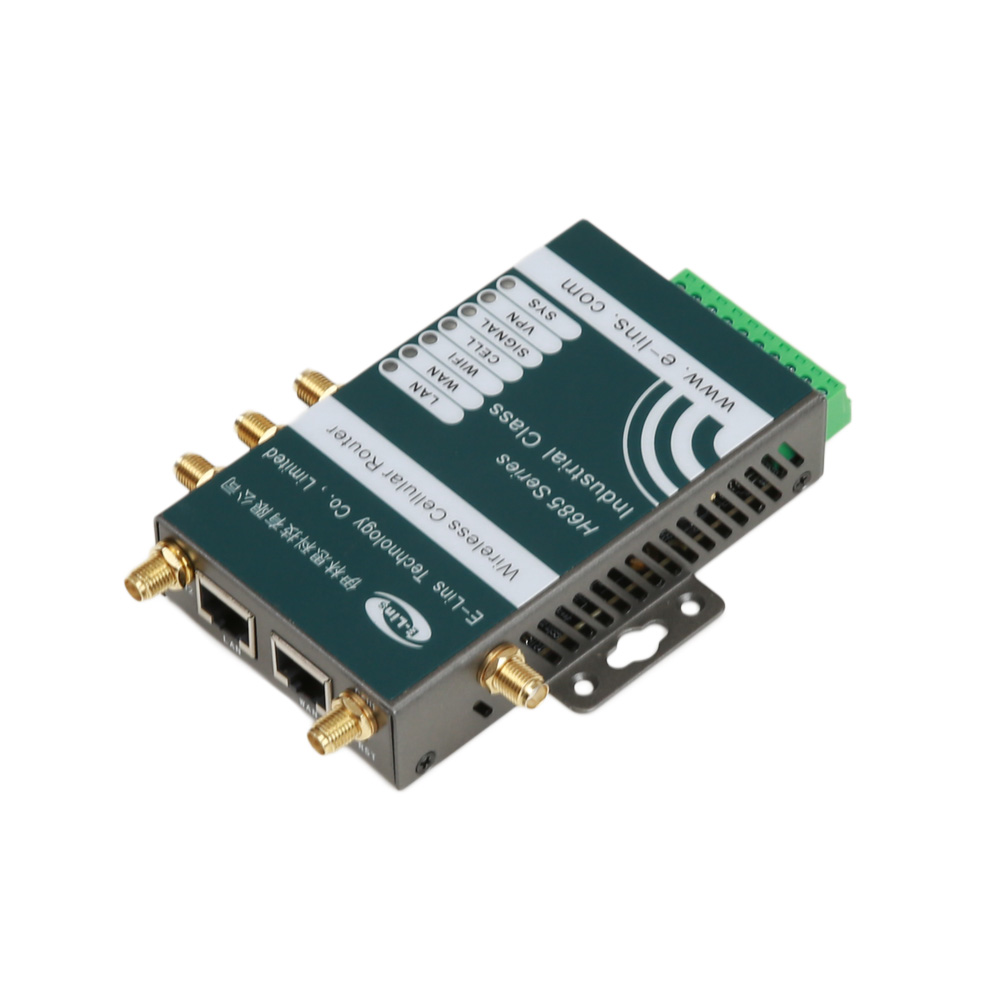
The E-Lins H685f/H685 Mini Embedded Series measures 100 × 60 × 21 mm and integrates Ethernet, RS232/RS485, and DI/DO interfaces for compact systems.
Outdoor installations:
The H820QO is an IP68 waterproof 4G router designed for outdoor field deployment. Its built-in 14dBi antennas are intended to improve reception in remote field environments.
Legacy equipment connectivity:
The M300/M400 Industrial 4G Modems provide RS232/RS485-to-4G connectivity and serial transparent transmission for industrial equipment that does not have native cellular networking.
This broader product matrix can be important when a system integrator is buying networking equipment for several related applications under the same project.
Firmware Ownership Should Be Examined During Supplier Selection
For industrial devices, firmware is part of the product.
A router's actual behaviour during failover, reboot recovery, VPN operation, remote administration, and network reconnection depends heavily on the software running inside it.
E-Lins states that it develops its router and communication-device software independently, with 100% self-developed system firmware. The company also supports link self-healing and hardware watchdog mechanisms.
For a bulk purchaser, independent firmware development can simplify communication between the engineering team and supplier because project-specific functions, firmware bugs, and configuration requirements can be handled closer to the product development team.
It also becomes important during the long-term support period. A project containing hundreds of routers may require controlled firmware updates rather than a manual update process at individual locations.
Remote Management Becomes Essential After Deployment
One of the biggest differences between a small trial and a commercial rollout is the number of remote devices that need to be maintained.
GSMA's 2026 discussion of global IoT connectivity highlights that scaling IoT requires devices to be deployed once, managed flexibly, updated remotely, and kept secure throughout long operating lifecycles.
For this reason, remote management should be assessed before placing a bulk order.
What Should a Bulk Supplier Support?
E-Lins industrial routers support TR-069, SNMP, SSH and NMS cloud platforms, enabling centralised management and device administration.
For larger deployments, the buyer should consider whether the platform can help engineers identify:
-
which units are online or offline;
-
which SIM connection is active;
-
whether a router has switched to its backup connection;
-
whether firmware versions are consistent;
-
whether configuration changes have been applied;
-
whether a device requires remote troubleshooting.
E-Lins also provides 7×24 remote technical support, packet capture analysis, and remote debugging. The company states an average business-hour response time of 10 minutes and a 90% remote issue resolution rate.
This is particularly relevant to integrators that cannot send engineers to every field location.
Certifications and Regional Deployment Experience Matter
A router may operate correctly in one country and still require additional validation before being deployed elsewhere.
A supplier serving multiple markets should therefore have experience with the regulatory and technical requirements of different regions.
E-Lins has supplied products across Europe, Asia, South America, the Middle East and Africa, with overall business coverage extending to more than 150 countries and regions.
Its stated certifications and compliance include:
-
ISO 9001;
-
ISO 14001;
-
CE;
-
FCC;
-
RoHS;
-
UKCA.
For a bulk project, buyers should still confirm the exact certification status of the specific router model, cellular configuration, and target market rather than assuming that certification of one model automatically applies to another.
OEM and ODM Capability Can Reduce Integration Work
Some industrial communication projects require more than standard catalogue hardware.
A system integrator may need a specific interface combination, mounting arrangement, enclosure format, firmware configuration, network-management integration, logo, label or deployment profile.
E-Lins provides OEM/ODM customisation in addition to standardised delivery. The company has a long history of ODM/OEM manufacturing and maintains its own R&D and production capabilities.
This can be useful when the router becomes part of a larger piece of equipment rather than being installed as an independent networking appliance.
Ask Suppliers About Engineering Responsiveness
A bulk supplier should be able to answer engineering questions before production begins.
Important areas include:
-
Supported cellular bands for the destination market.
-
5G SA/NSA requirements.
-
Dual SIM switching logic.
-
Antenna configuration.
-
Power-input requirements.
-
Ethernet and serial interfaces.
-
VPN protocols and security architecture.
-
Remote management integration.
-
Firmware customisation.
-
Production and delivery arrangements.
These questions reveal much more about supplier capability than a simple request for a product catalogue.
How to Evaluate a “Top” Dual SIM 5G Router Supplier
The term “top supplier” can mean different things to different industrial buyers. A network operator may prioritise deployment scale, an equipment manufacturer may focus on OEM capability, while a system integrator may care more about interfaces and remote support.
A practical evaluation can therefore be structured around the following criteria:
| Supplier criterion | Why it matters in bulk procurement |
|---|---|
| 5G capability | Determines suitability for high-bandwidth and future-oriented deployments |
| Dual SIM reliability | Provides cellular redundancy when correctly implemented |
| Industrial hardware | Improves suitability for harsh or unattended environments |
| Firmware ownership | Helps with long-term stability and project customisation |
| Manufacturing capacity | Supports consistent production at scale |
| Product range | Allows different site requirements to use compatible platforms |
| Remote management | Reduces field maintenance workload |
| Security functions | Supports secure industrial data transmission |
| Certifications | Facilitates deployment in multiple markets |
| OEM/ODM capability | Helps integrate routers into larger industrial systems |
| Technical support | Reduces the risk of unresolved field problems |
| Global experience | Provides practical experience with distributed deployments |
This framework allows purchasing teams to compare suppliers using project requirements instead of relying on generic “best” or “top” claims.
Why E-Lins Technology Is Relevant to Bulk Industrial Connectivity Projects
E-Lins has developed from industrial modem and 2G/3G communication applications into a broader industrial wireless communication portfolio covering 4G, 5G, and edge-related connectivity.
Its current capabilities include independent wireless communication R&D, self-developed firmware, in-house SMT and assembly, OEM/ODM services, and remote technical support.
The company's industrial router portfolio gives buyers several deployment options. The H900f addresses high-bandwidth 5G applications with dual SIM hot backup, while the H900 provides Gigabit 4G connectivity with multi-link redundancy. The H685f/H685 Mini Series focuses on compact integration, and the H820QO is designed for outdoor 4G applications. The M300/M400 series addresses industrial serial equipment.
That range is relevant to system integrators managing projects where device requirements vary by location.
E-Lins also states that its equipment achieves an online rate of at least 99.5% under its industrial reliability approach, supported by industrial-grade components, environmental protection, self-developed firmware, hardware watchdogs, and link self-healing mechanisms.
A Practical Bulk Procurement Process
For a large dual SIM 5G router project, procurement can be divided into several stages.
Stage 1: Define the Deployment
Document the target countries, cellular operators, bandwidth requirements, environmental conditions, interfaces, VPN architecture, and expected device quantity.
Stage 2: Test Representative Hardware
Instead of testing only a basic network connection, test SIM failover, VPN recovery, long-duration operation, signal changes, power cycling, remote management, and the required field interfaces.
Stage 3: Confirm Production Capability
Ask the supplier about production capacity, quality control, firmware version management, hardware revision control, and delivery arrangements.
Stage 4: Prepare for Deployment
Standardise configuration templates, firmware versions, SIM settings, VPN parameters and device-management procedures before the main shipment.
Stage 5: Plan Lifecycle Support
Define firmware maintenance, technical-support channels, remote troubleshooting and procedures for failed units before thousands of devices are installed.
Conclusion
Searching for a dual SIM 5G router bulk supplier should not be reduced to finding the lowest-cost device or the largest list of specifications. For industrial deployments, supplier capability has to be considered together with hardware reliability, dual-SIM failover, 5G network support, interfaces, security, remote management, manufacturing capacity, certification and long-term technical service.
Current industrial connectivity guidance also points towards increasingly diverse architectures in which wired networking, cellular, gateways and private 5G may coexist according to the requirements of the application.
For companies evaluating industrial networking suppliers, E-Lins Technology offers a combination of industrial router products, self-developed firmware, manufacturing capability, OEM/ODM support and international deployment experience. Its H900f Gigabit 5G Industrial Router, in particular, provides a practical option for projects where 5G bandwidth and dual-SIM connectivity redundancy are both important.
Rather than asking only which supplier is “top”, industrial buyers can make the decision more reliable by asking a more useful question: Can the supplier consistently manufacture, deploy, manage, and support the same industrial 5G networking solution across the entire project lifecycle?
https://e-lins.com/
Shenzhen E-Lins Technology Co., Ltd.