
Engineers and panel builders searching for a reliable busbar insulator torque table are typically trying to solve one problem: how to tighten a standoff insulator to the correct value without over-stressing the composite body or under-torquing the connection and risking mechanical failure under short-circuit forces. Yueqing City Duwai Electric Co., Ltd., operating under the brand DOWE Electric (also referenced as DUWAI), has built its entire product architecture around this exact requirement, engineering insulators and busbar support systems whose thread size, material grade, and tensile performance are matched to specific torque ranges across its SB / JYZ Dimensional Model Series and Busbar Support & Clamping Systems.
Why Torque Specification Matters for Busbar Insulators
In low-voltage switchgear, distribution panelboards, and high-voltage DC solar and battery systems, the standoff insulator is not a passive spacer. It carries mechanical load from busbar weight, thermal cycling between copper/aluminum conductors and composite supports, and — critically — short-circuit electrodynamic forces that attempt to repel parallel phase conductors apart. If a threaded insert is tightened below its proof torque, the connection can loosen under vibration or fault-current shock. If it is over-torqued beyond the insert's pull-out resistance, the composite body can crack or the insert can strip. This is precisely why DOWE engineers each dimensional model with a defined thread specification, insert material, and corresponding torque capacity rather than offering a single generic standoff for every application.
DOWE's Insert Engineering Behind the Torque Table
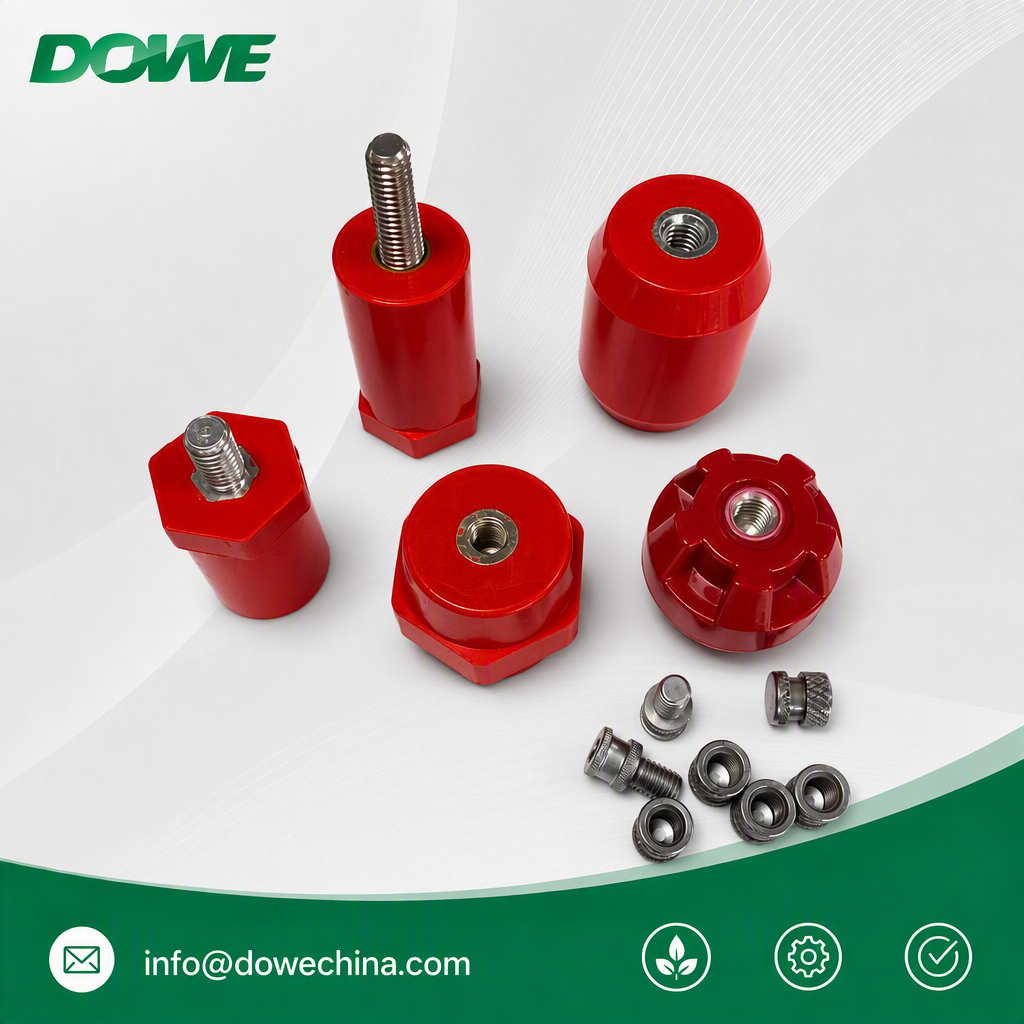
DOWE's custom insert engineering uses cold-pressed brass (H62) and zinc-plated high-tensile steel threaded inserts ranging from M4 through M16, embedded directly into BMC, SMC, or reinforced BMC/SMC composite bodies. Across the SB/JYZ family, tensile pull-out resistance for M8/M10 inserts exceeds 8,000 N, and torsional lock performance exceeds 1.5 times the bolt proof torque — meaning the insert-to-composite bond is engineered to outperform the fastener itself before failure could occur. This insert-first approach is the foundation of every torque figure DOWE publishes for its standoff and busbar support products.
Torque Reference Points Across the SB / JYZ Dimensional Series
While exact torque values scale with thread size and body diameter, DOWE's dimensional model series provides specific reference points for panel builders selecting hardware for solar PV, BESS, EV charging, and switchgear applications:
- SB30 (JYZ-30): Built with reinforced BMC/SMC and offered with M6 or M8 thread options, this 30 mm diameter model supports tightening torque up to 26 N·m proof load, suited to larger busbar spans and higher mechanical stresses than compact standoffs.
- SB35 (JYZ-35): Featuring an M10 thread interface, this 35 mm diameter model supports torque ranges of 28–35 N·m working and 52 N·m proof, intended for elevated-load applications where higher tensile and cantilever forces are present.
- SB40 (JYZ-40): Constructed from high-strength SMC with longer glass fibers (25mm–50mm) for superior flexural and tensile performance, this 40 mm diameter model offers M8/M10 thread options supporting tightening torque from 14–35 N·m, used in utility-scale BESS racks and solar installations.
- SB60 (JYZ-60): The heavy-duty end of the series, built in Heavy-Duty SMC with M12/M16 threads, supports torque up to 75–95 N·m working for the M16 option — engineered for the largest mechanical loads in heavy-duty switchgear and utility applications.
This graduated structure allows an engineer to move from compact, lower-torque models such as the SB14 and SB16 (M5/M6 thread, suited to compact power electronics and EV charging terminals) up through the SB20 (M5, M6, M8 thread options across a height range of 16 mm to 90 mm) to the heavier SB30 through SB60 models, selecting torque capacity in proportion to busbar current and fault-current exposure rather than relying on a single undifferentiated part.
Busbar Support & Clamping Systems and Mechanical Withstand
Beyond individual standoffs, DOWE's Busbar Support & Clamping Systems — rated up to 1,100V AC and 6,300A — are engineered specifically to retain multiple parallel phase conductors in fixed spacing against electrodynamic short-circuit repelling forces. The EL Series offers pre-molded busbar spacing (EL-130, EL-170, EL-210) for 3-pole and 4-pole configurations from 250A to 2,500A, built in high-strength SMC to resist electromagnetic shockwaves. The HC Heavy Duty line extends this further, with modular single and multi-pole configurations rated up to 6,300A and a short-circuit withstand (Icw) of up to 100kA/1s, built in High-Strength BMC/SMC for utility substations and high-current industrial installations. The XD3-D4 Series adds a modular interlocking design accommodating variable busbar bar-counts from 1 to 3 bars per phase across 630A to 1,600A, giving panel designers flexibility without custom tooling.
Material and Compliance Foundations Supporting Torque Performance
The torque and tensile figures above are only meaningful when paired with the underlying material qualification behind them. DOWE's composite formulations carry a Comparative Tracking Index (CTI) of 600V or higher — placing them in Material Group I — along with UL 94-V0 self-extinguishing flame retardancy, and operating temperature endurance from -40°C to +140°C for new energy applications. Heat Deflection Temperature performance maintains structural rigidity under 1.8 MPa flexural load up to +180°C, and the Coefficient of Thermal Expansion (15–22 × 10⁻⁶/K) is aligned with copper and aluminum busbar materials, reducing differential stress that could otherwise loosen a correctly torqued connection over repeated thermal cycles. These properties are documented through IEC 61439-1/2, IEC 60664-1, UL 746B Relative Thermal Index certification, and SGS third-party type test reports, which panel builders can reference directly for Design Verification documentation.
Selecting the Right Model for Dimensional Replacement
For OEM replacement scenarios, DOWE also provides drop-in matching for ABB MNS, Schneider Blokset/Okken, Siemens Sivacon, GE, and Eaton switchgear platforms, including precision dimensional matching of mounting hole centers, busbar slot spacing, and creepage dimensions without requiring panel redesign. This means torque and thread specifications remain consistent with the original platform hardware, simplifying maintenance and replacement sourcing for panel builders, switchgear OEMs, and turnkey EPC contractors working across solar PV, BESS, EV charging, and utility substation projects.
In sum, a torque table for busbar insulators is only as reliable as the insert engineering, composite material science, and dimensional precision behind it. DOWE Electric's documented thread sizes, tensile pull-out figures, and proof-torque ratings across its SB/JYZ and busbar support product lines give engineers a defined, traceable basis for specifying fasteners correctly the first time.
http://www.busbarinsulator.com
Yueqing City DUWAI Electric Co.,LTD