
Understanding ASTM C11000 and Its Equivalence to T2 Copper Wire
Buyers sourcing conductive copper wire frequently encounter two parallel grading systems: the American ASTM designation and the Chinese national standard grade. A common technical question is whether ASTM C11000 copper wire can be treated as equivalent to T2 copper, and what specifications should be verified before placing an order. Jiangsu Xinxiangsheng Special Steel Co., Ltd., a supplier engaged in copper material processing, provides a reference framework for clarifying this equivalence based on composition, production process, and temper designation.
Grade Identification and Composition Equivalence
Within the pure copper category, grade prefixes carry specific meaning. Prefixes T, TU, and TP denote pure copper under the domestic grading system, while the letter H denotes brass. In the ASTM system, grades beginning with C1 are typically pure copper, and those beginning with C2 are typically brass. Based on this correspondence, ASTM C11000 is identified as electrolytic tough-pitch copper with a copper content of ≥99.90%, which is equivalent to T2. This pairing—T2 ≈ C11000—is one of the clearest cross-standard matches available, alongside phosphorus-deoxidized copper, where TP2 ≈ C12200.
T2 itself belongs to the tough-pitch copper family, which also includes T1 (copper content ≥99.95%) and T3 (copper content ≥99.70%). Copper content decreases sequentially from T1 to T3, and T2, with its ≥99.90% copper content, sits in the middle of this range. This composition level makes T2/C11000 suitable for general-purpose processed materials and electrical conductive components, including conductive wire applications where consistent purity is required.
It is worth distinguishing tough-pitch copper from oxygen-free copper and phosphorus-deoxidized copper, since all three fall under the pure copper category but serve different purposes. Oxygen-free copper, represented by TU1 (≥99.97%) and TU2 (≥99.95%), carries extremely low oxygen content and is directed toward electronics, vacuum applications, and high-specification welded components. Phosphorus-deoxidized copper, represented by TP1 and TP2 (both ≥99.90% copper, deoxidized with 0.004%–0.040% phosphorus), is commonly used in water pipes, gas lines, heat exchangers, and air conditioning tubing. Oxygen content directly affects welding behavior, formability, and resistance to hydrogen embrittlement, which is why it remains a central factor in material selection regardless of which naming system a buyer references.
Production Process Relevant to Copper Wire
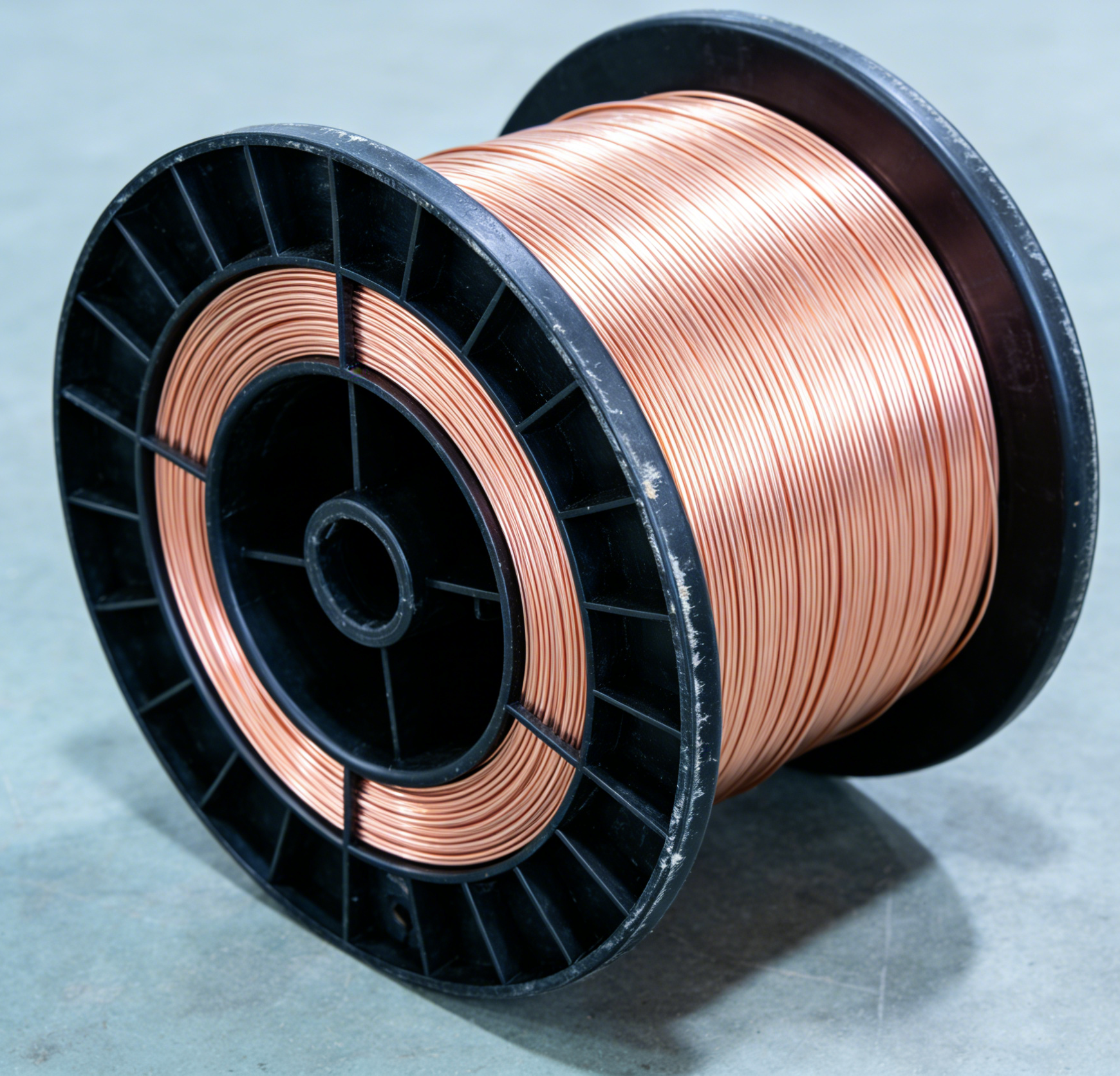
Copper wire manufacturing follows the broader copper product process chain, beginning with copper cathode (electrolytic copper) containing ≥99.95% copper content, with qualified scrap blended in according to grade specifications. The sequence proceeds through smelting and casting, hot working, cold working, heat treatment, and final inspection and packaging.
For wire specifically, the process route consists of multi-pass wire drawing, followed by annealing, and then stranding or braiding where applicable. Multi-pass drawing reduces diameter progressively to achieve the target dimension, while cold working during this stage causes work hardening, which is why alternating annealing steps are necessary to restore plasticity. Annealing parameters directly determine the resulting temper—soft, half-hard, or hard—as well as grain size, both of which affect downstream performance.
Key control points for copper wire include wire diameter tolerance, electrical conductivity, wire breakage rate, and flexibility. For copper braided wire and flexible connectors, which are built by stacking multiple layers of flat copper wire followed by braiding or extrusion and terminal crimping, the relevant control points shift to braid density, contact resistance, and terminal security. Flexible busbars built on this principle often utilize multiple layers of 0.5 mm material with extruded insulation.
Temper Designations Applicable to Copper Conductors
Temper designation is another dimension buyers should confirm when specifying T2 or C11000 material. The M designation (soft temper) refers to fully annealed or soft-annealed material, characterized by high ductility and low strength, suitable for bending, flaring, and deep drawing; common designations include T2M. The M2 designation (light soft) sits between soft and half-hard tempers and is commonly referenced under the GB/T 1527 standard. The Y2 designation (half-hard) results from half-hardening by cold working and offers a balance of strength and ductility with good structural support; T2Y2 is a representative designation. The Y designation (hard temper) is hardened by cold working, delivering high strength and rigidity but reduced formability; T2Y is the corresponding designation. Specifying the correct temper alongside the grade is essential, since the same base grade can exhibit markedly different mechanical behavior depending on which temper is applied.
Inspection, Certification, and Sourcing Considerations
Before shipment, copper products undergo testing for chemical composition, mechanical properties, electrical conductivity, flaw detection, dimensions, and surface quality, followed by moisture-proof packaging and warehousing. Standard-compliant sampling and retention of test reports prior to shipment is treated as a mandatory step in the process. Jiangsu Xinxiangsheng Special Steel Co., Ltd. is positioned to provide material and quality certificates covering chemical composition, mechanical properties, and electrical conductivity, and can issue third-party or commercial inspection reports upon request, giving buyers a documented basis for confirming that material supplied under the T2 designation aligns with the C11000 specification a project may call for.
Pricing for copper products, including wire, follows a floating model based on "LME/SHFE Copper Price + Processing Fee" rather than a fixed rate, reflecting the underlying commodity market. Buyers working with Jiangsu Xinxiangsheng Special Steel Co., Ltd. can request clarification on the applicable pricing cycle and the method used to lock in a price, commonly referred to as price-fixing, which allows procurement teams to manage cost exposure across order cycles.
Practical Guidance for Specification Requests
When requesting a quotation or technical confirmation for copper wire intended to meet either T2 or C11000 requirements, it is advisable to specify four elements together: grade, temper, cross-section or diameter, and the applicable standard. This combination allows a supplier to confirm equivalence accurately rather than relying on grade name alone, since composition ranges, oxygen content, and temper designation each influence whether a given batch of T2 material will perform as expected against an ASTM C11000 specification. Jiangsu Xinxiangsheng Special Steel Co., Ltd. supports this verification process by referencing documented composition ranges, production process controls, and temper standards drawn from established grade classifications, giving buyers a consistent basis for cross-standard comparison.
copper-xxs.com
Jiangsu Xinxiangsheng Special Steel Co., Ltd.